
Let me tell you how the article you're reading usually gets made.
Somebody types "best link building companies" into a keyword tool, sees 2,400 monthly searches with a juicy commercial intent score, and assigns a writer 2,000 words. The writer has never bought a link in their life. They open Clutch, copy ten agency names, paste the boilerplate from each homepage, sprinkle in phrases like "white-hat" and "data-driven," and hit publish. Then the agency that owns the blog puts itself at number one and calls the whole thing a comparison.
You've read forty of these. They all say Siege Media does content. They all say uSERP is good for SaaS. Not one of them tells you what happens in month four when the outreach stalls and your account manager starts scheduling "strategy syncs" instead of sending you live URLs.
So here's the deal. I'm going to give you the ten companies, because you came for ten companies. But I'm also going to hand you the decoder ring for every other list you'll read today, because the skill you actually need isn't picking from a list. It's knowing which lists to throw out.
Full disclosure, up front, where it belongs
Page One Power is on this list, at number one, and Page One Power is us. I put us first because this is our blog and pretending otherwise would insult you.
Here's what makes that different from the usual game: I'm going to tell you exactly who we're wrong for. Three of the companies below will serve you better than we will depending on your budget, your team, and your appetite for managing things yourself. I'll say which and why. Nobody on this list paid to be here and nobody paid to be left off.
That's the bar. Any roundup that won't clear it is an advertisement wearing a lab coat.
The four tells of a garbage list
Before the list, the decoder ring. Four things to check, takes ninety seconds:
1. Is the publisher on their own list? Fine, if they say so. Suspicious if they bury it in a footer. Disqualifying if the "objective methodology" happens to produce them at number one and they never mention owning the site.
2. Does every agency get a compliment? Real evaluation produces real tradeoffs. If all ten companies are "excellent choices for brands seeking authoritative backlinks," you are reading a directory listing that has been taught to smile.
3. Are there any numbers? Not "affordable pricing" or "custom quotes available." Actual dollars. Actual link counts. A list with no prices is a list written by someone who never got a quote.
4. Do they name a bad fit? The single fastest test. Every agency on earth is wrong for somebody. A writer who can't tell you who is a writer who copied homepages.
Run those four on the next tab you have open. I'll wait.
1. Page One Power
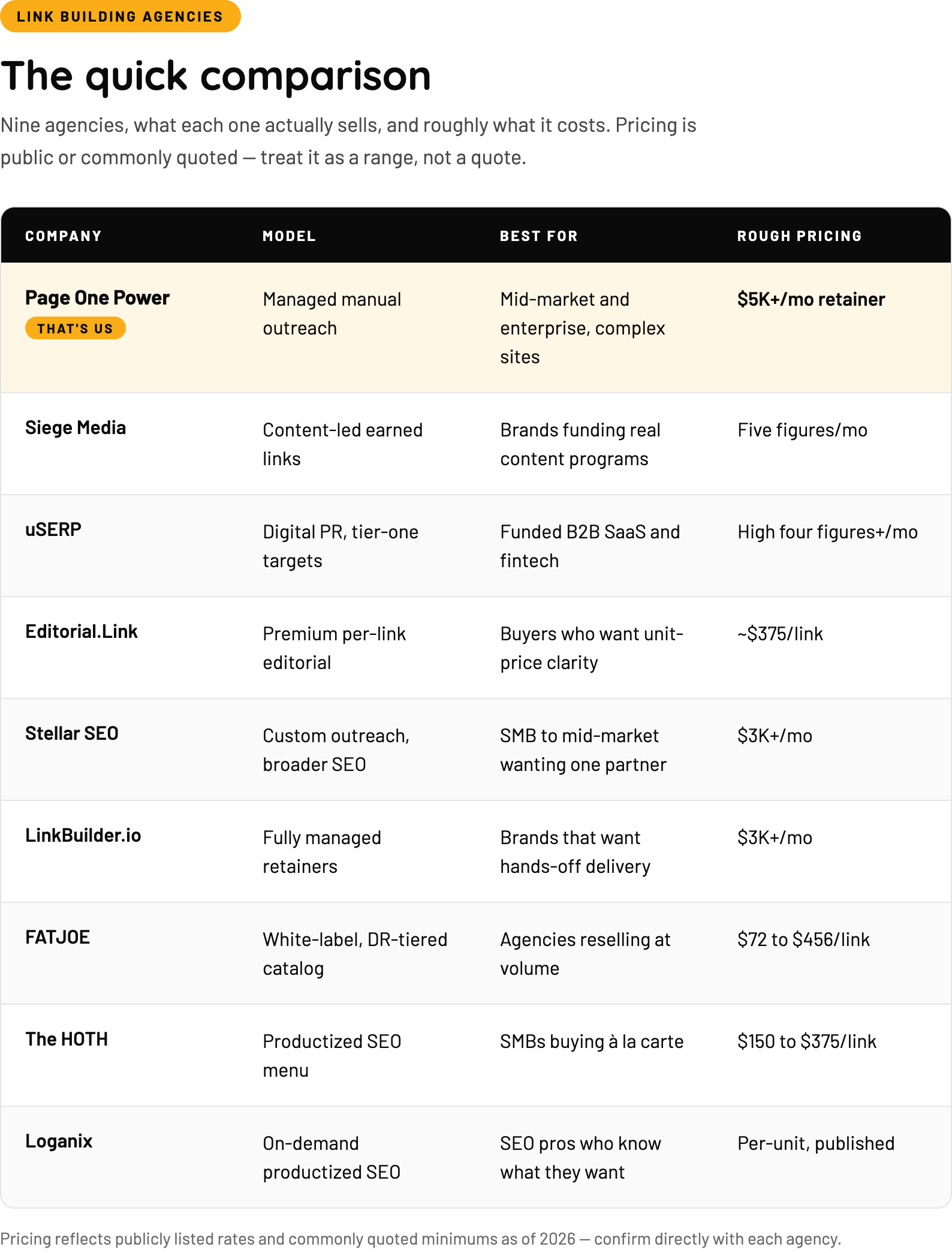
Best for: Mid-market and enterprise sites where the link strategy has to survive contact with a real business. Regulated industries, big content libraries, sites where "just build 15 links" is not a plan.
What we actually do: Manual outreach and editorial placement, prospected per client, no marketplace, no network. We've been at this since 2010, which in link building years is roughly the Cretaceous. The framework is seven distinct link types matched to what the page actually needs, because a product page and a resource hub want different things and treating them the same is how campaigns quietly go nowhere.
Where we're wrong for you: If you need links next Tuesday, go elsewhere. If your budget is under $5,000 a month, go elsewhere. If you're an agency that wants white-label fulfillment you can mark up, genuinely go elsewhere, that's FATJOE's whole business and they're better at it than we would be. We are a slow, expensive, high-touch option and that's a feature for some buyers and a dealbreaker for others.
2. Siege Media
Best for: Brands willing to fund content that earns links instead of content that begs for them.
Siege runs the model everyone claims to run and almost nobody actually does. They build the asset first, the research piece or the interactive or the genuinely useful tool, and the links arrive because publishers want to cite it. Founded 2012, San Diego, and they've been consistent about this for long enough that it's not a positioning exercise.
The catch: this is a content investment with a link outcome, not a link purchase. You're paying for design, research, and production before a single placement lands. Budget five figures monthly and be patient. If your CFO wants a link count on a spreadsheet by day 30, this model will make everyone miserable.
3. uSERP
Best for: Funded B2B SaaS and fintech chasing tier-one publications.
Digital PR style outreach aimed at brand-name domains, founded 2019, with a client roster that includes the kind of logos that make your board nod. Fully in-house team, no outsourced outreach, senior strategists running accounts rather than a coordinator forwarding emails.
The catch: the price assumes the target list. High four figures monthly minimum and climbing, which is correct for the placements and comically wrong for an SMB retainer. If you're a regional HVAC company, this is like hiring a Michelin kitchen to make you a sandwich.
4. Editorial.Link
Best for: Buyers who want to know the unit price before they sign anything.
Published rate of roughly $375 per backlink, with a starter package around $1,750 for five links targeting DR 50 to 90 sites with real traffic. Relationship-based editorial placement, senior project management, and they've leaned hard into getting clients cited in AI Overviews and ChatGPT alongside the traditional link value.
The catch: per-link pricing is clean but it can turn strategy into shopping. You'll be tempted to optimize for the metric on the invoice instead of the page that actually needs authority. Bring your own priorities or you'll end up with a beautiful DR average and no movement.
5. Stellar SEO
Best for: SMB to mid-market brands that want link building attached to the rest of their SEO instead of floating off on its own.
Custom outreach, longer strategy conversations than the productized shops, and a broader service menu if you'd rather not manage four vendors. They show up on basically every credible list in this space, which at this point is its own signal.
The catch: breadth cuts both ways. If links are the only gap in an otherwise healthy program, you may be paying for account overhead you don't need.
6. LinkBuilder.io
Best for: Brands that want fully managed monthly delivery and would like to think about it as little as possible.
Competitor analysis to identify target pages, bespoke campaigns, and a range of techniques rather than one repeated motion. Also offers white-label if you're an agency. 300+ brands served and the managed monthly package is clearly the center of gravity.
The catch: "we use over 20 techniques" is a great sales line and a hard thing to audit. Ask which three they'll actually use on your site, and ask in the sales call, not month two.
7. FATJOE
Best for: Agencies reselling link building at volume with predictable margin.
The pricing is the pitch and it's genuinely transparent: roughly $72 at DR10+, $96 at DR20+, $120 at DR30+, $216 at DR40+, $336 at DR50+, $456 at DR60+. Content included, fast turnaround, ordering workflow built for people placing a lot of orders.
The catch: you are buying to a DR threshold, not to a strategy. DR is a proxy and proxies get gamed. Spot-check organic traffic on the placements yourself rather than trusting the tier label, and understand that nobody at FATJOE is thinking about whether this link should point at your pricing page or your guide.
8. The HOTH
Best for: SMBs and marketers who want a menu, a price, and a checkout button.
Productized down to the item level. Link Outreach around $150, Link Insertions around $200, Platinum Links around $375. One vendor for a lot of SEO odds and ends, not just links.
The catch: menu-buying works when you already know what you need. If you're guessing, you'll buy the wrong items efficiently. Nobody here is going to stop you.
9. Loganix
Best for: In-house SEOs and agency operators who know exactly what they want and want it on demand.
Wide suite of SEO services with links orderable as units. Published pricing, low strategy overhead, no discovery call required to find out what something costs.
The catch: same as every productized play. The strategy is your job. That's a bargain if you have the chops and a trap if you don't.
10. Outreach Monks
Best for: Smaller budgets that still need real, managed outreach rather than a marketplace.
Managed campaigns at a friendlier price point, popular with growing businesses and agencies that need steady velocity without a five-figure commitment.
The catch: at the value tier, verify harder. Ask for live placement URLs from the last 60 days in your vertical, then check organic traffic on every one of them yourself.
What this actually costs, since nobody else will say
Here's the pricing reality as of 2026, pulled from published rate pages rather than vibes.
A quality editorially placed backlink on a DR 30 to 50 site runs roughly $300 to $500. Premium DR 70+ placements clear $1,000 and can run past $3,000. Guest posts on mid-tier sites land around $300 to $600 with content included, and DR 50+ pushes into the $600 to $1,500 range because acceptance rates on those sites drop to something like 5 to 10 percent. That acceptance rate is the whole explanation for the price, by the way. You are not paying for an email. You are paying for the nineteen that got ignored.
On retainers: most quality programs run $1,500 to $10,000 a month. A 2026 uSERP buyer survey found 46.5 percent of respondents spending $5,000 to $10,000 monthly on link building alone, with another 18 percent above $10,000. Editorial.link's research put the average price SEOs say they're willing to pay per link at just over $500, and found link acquisition eats roughly a third of a typical SEO budget.
And the line that matters most: under $100 per link for a DR 30+ site is a warning, not a deal. At that price the math doesn't support manual outreach by a human being who speaks your language. What you're buying is a private blog network, a zero-traffic domain, or a site that will accept anything. Those links cost more than they save, just later, and in a currency you'd rather not pay in.
How to actually vet one of these companies
Forget the list. Here's the diligence that separates buyers who get results from buyers who get invoices.
Ask for live URLs, not a case study. Ten placements from the last 90 days, in or adjacent to your vertical. A case study is a story. A URL is a fact.
Check the placements in Ahrefs yourself. Not DR. Organic traffic to the specific linking page, and whether that page ranks for anything. A DR 68 domain with a DR 68 sitewide and 40 monthly visitors to the article your link sits in is a decoration.
Ask who writes the outreach email. Then ask to see one. If it's a template with a mail-merge field where your brand goes, you now know what you're buying and can price it accordingly.
Ask what happens in month one. The honest answer involves prospecting and relationship groundwork and probably fewer links than months three through six. Anyone promising steady volume from week one is either using a network or about to disappoint you politely.
Ask who is wrong for them. The single best question in the entire sales process. An agency that can't name a bad-fit client either doesn't understand their own model or is willing to take your money knowing it won't work. Both are useful to learn in a sales call rather than in month five.
FAQ
How much does link building cost per month? Most quality retainers run $1,500 to $10,000, with the bulk of serious buyers landing in the $5,000 to $10,000 range. Local and SMB programs can work starting around $1,000 to $2,000. Competitive verticals like SaaS, legal, and finance generally need $5,000 to $15,000 to move anything.
How long until link building works? Three to six months for measurable movement in most cases, longer in competitive verticals. Anyone quoting 30 days is selling something that arrives fast because it was already sitting on a shelf.
Is buying links against Google's guidelines? Paying for a link with the intent to manipulate rankings violates Google's spam policies. What legitimate agencies sell is the labor of earning placements: prospecting, content, outreach, relationships. The distinction is real, and it's also exactly the line that gets blurred by anyone selling DR-tiered links at $72 a pop. Know which one you're buying.
Should I use an agency or do it in-house? In-house wins if you have a writer, an outreach person, and a manager who has done this before. That's roughly $150K in salary to replace a $60K retainer, which is why most teams outsource. It flips when you're building enough volume that the fixed cost amortizes.
Do links still matter with AI search? More than they did, not less. The sources that get cited in AI Overviews and ChatGPT answers are disproportionately the ones with authority signals underneath them, and links remain the primary way that authority gets established. The link is the same asset. It now pays out in two places.
The short version
The list you just read has ten companies on it. So does every other list. The difference between a good buying decision and a bad one was never which ten names got printed.
It's whether you asked for live URLs. Whether you checked the traffic yourself. Whether anyone told you who they're wrong for.
Ask better questions and any of these ten can work for the right buyer. Skip that part and it won't matter whose logo sits at number one, including ours.