

Survey data from 1,000 marketing practitioners shows adoption racing ahead of trust, GEO strategy outpacing GEO measurement, and the industry's most defensible tactic sitting at the bottom of the priority list.
We’ve got ourselves in a pressure packed adoption push, yet a falling trust metric that makes for yet another very interesting time to be in the search marketing industry. Our internal survey of marketers found that 74% of respondents increased their daily use of AI tools over the past year. However, over that same period, 43% of respondents say their trust in AI-generated answers has actually declined.
The average consumer of AI uses it for simple tasks and asks simple questions; they typically aren’t relying on it for business output, which is a much higher standard. The irony is, we (internet marketers) know better, we use the tools, yet we trust them less. Despite that declining trust, there is pressure to adopt AI at a rapid pace. So, in this paradox, the people being forced to adopt it are the ones who trust its output less and less.
To understand how practitioners (not consumers) are actually navigating AI search, we surveyed 1,000 U.S. digital marketing professionals across SEO, content, paid media, digital PR, social, analytics, and marketing leadership roles. The panel spanned solo freelancers to enterprise teams at companies with more than 1,000 employees.
Here's what the data means for your position or agency in 2026.
Adoption is no longer the question
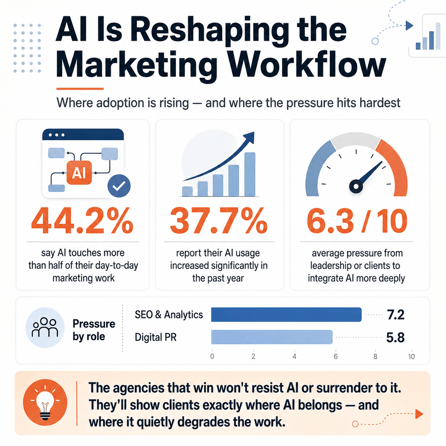
AI is now embedded in the daily work of nearly half the industry. Among respondents, 44.2% say AI touches more than half of their day-to-day marketing work, and 37.7% report their usage increased significantly in the past year alone.
The pressure to adopt isn't evenly distributed. On a 10-point scale, the average marketer reports a 6.3 level of pressure from leadership or clients to integrate AI more deeply. SEO and analytics roles feel it hardest at 7.2. Digital PR sits lowest at 5.8, which tracks: relationship-driven work is the hardest to hand to a machine.
For agencies, the takeaway is simple. Your clients' internal teams are being pushed to use AI, whether or not it improves the work. The agencies that win won't be the ones that resist that pressure or surrender to it. They'll be the ones that can tell clients specifically where AI belongs in the workflow and where it quietly degrades the output.
The people using AI most trust it least
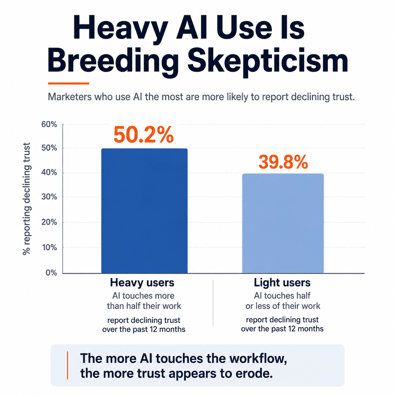
Familiarity is breeding skepticism. Among heavy users, those with AI touching more than half their work, 50.2% report declining trust over the past 12 months. Among light users, that figure is 39.8%.
The pattern inverts the usual adoption curve. Normally, usage and confidence rise together. Here, the practitioners with the most hands-on exposure are the ones most likely to have caught the tools being wrong.
They can name the reason, too. Among everyone reporting a trust decline, 44.6% point to hallucinations and factual errors they personally caught. Inconsistent answers, source opacity, and brand bias split the remainder.
Only 16.8% of marketers say their trust increased. And on the five-year question, the industry is genuinely split: 47.6% believe AI will replace traditional search engines as the primary discovery tool, while the rest are unsure or skeptical.
Average trust in AI factual accuracy lands at 3.1 on a 5-point scale. Not broken. Not earned. Probationary.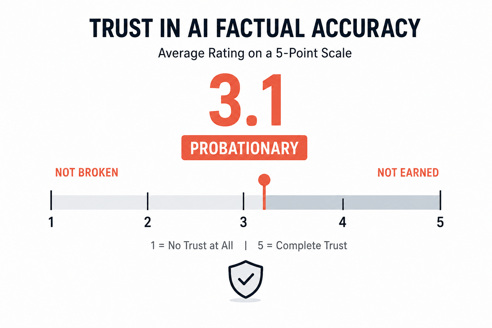
GEO strategy is racing ahead of GEO measurement
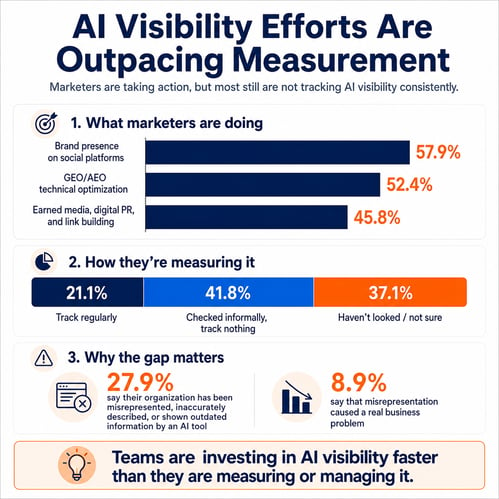
Ask marketers what they're doing about AI visibility and the answers come fast. Building brand presence on social platforms leads at 57.9%, followed by GEO/AEO technical optimization at 52.4% and earned media, digital PR, and link building at 45.8%.
Ask them how they're measuring it and the room gets quiet.
Only 21.1% of marketers track their brand's visibility in AI tools with any regularity. Another 41.8% have checked informally but track nothing. The rest haven't looked at all or aren't sure.
That measurement gap has consequences. Among all respondents, 27.9% say their organization has been misrepresented, inaccurately described, or given outdated information by an AI tool, and 8.9% say the misrepresentation caused a real business problem: a lost sale, a damaged customer relationship, or a PR situation.
More brands have been misrepresented by AI than have a formal process for catching it. If a chatbot is describing your client's product incorrectly right now, the odds are nobody on the account knows.
The agency opportunity here is direct. AI visibility auditing and monitoring is a service most in-house teams admit they don't have, attached to a risk most of them have already experienced.
The most defensible tactic is the least funded
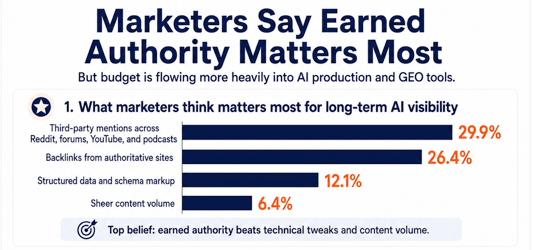
Here's the strategic inversion in the data. When asked which signal matters most for long-term AI visibility, marketers gave the top two spots to third-party mentions across Reddit, forums, YouTube, and podcasts (29.9%) and backlinks from authoritative sites (26.4%). Structured data and schema markup, the tactic that dominates GEO conference talks, drew just 12.1%. Sheer content volume came in last at 6.4%.
Practitioners, in other words, already believe earned authority is the moat. Their budgets say otherwise.
Only 19.1% of marketers list original research and proprietary data among their active visibility strategies, dead last among defined tactics. And in budget planning for the next 12 months, original research is the only category where more teams are cutting (27.8%) than investing (20.2%).
Meanwhile, AI content production tools lead all budget categories with 54.4% of teams increasing spend, followed by GEO-specific tools at 50.9%.
Read those two findings together and the picture is uncomfortable. The industry is pouring money into the tactics AI makes cheap for everyone, production speed and optimization tooling, while defunding the one asset class AI cannot replicate: original data nobody else has.
There is one bright spot for the earned side of the ledger. Link building and digital PR budgets are net positive, with 34.5% of teams increasing spend against 17.2% cutting. Some portion of the market has done the math.
The barrier isn't budget. It's skill.
When asked what's blocking deeper GEO and AI-search work, the top answer wasn't money. Lack of internal skills and training led at 25.5%, ahead of unclear ROI (19.6%) and budget (18%).
Leadership buy-in barely registered. Executives want this. Teams don't yet know how to deliver it, and average confidence in their own GEO strategy sits at exactly 3.0 out of 5. The industry has graded itself a C.
That's the environment agencies are selling into for the next 12 months: mandated adoption, eroding trust, unmeasured risk, and a skills gap the client already admits to.
What this means for your agency
-
Sell measurement before optimization. Nearly 80% of brands can't tell you what AI says about them. An AI visibility audit is the lowest-friction entry point in the market right now, and 27.9% of prospects have already been burned.
-
Fund the moat clients are ignoring. Practitioners rank third-party mentions and authoritative backlinks as the strongest AI-visibility signals, then fund AI content tools instead. The gap between what the industry believes and what it budgets is your positioning..
The brands that win AI search won't be the ones producing the most content the fastest. They'll be the ones consistently validated by sources, AI systems, and audiences that actually trust. That was true of Google's algorithm for two decades. The venue changed. The physics didn't.
Methodology
We surveyed 1,000 U.S. digital marketing practitioners via an online panel. Respondents spanned SEO/organic search (roughly a quarter of the sample), content marketing, paid media, digital PR and link building, marketing leadership, social, and analytics roles, across organizations from solo consultancies to enterprises with more than 1,000 employees. The sample was 56% male and 44% female, with an average age of 39. Multi-select questions allowed multiple responses, so totals may exceed 100%. Sub-2.5-minute completions were flagged and reviewed prior to analysis.