

Most people have no idea what link building is, or that it even exists.
Link building (also spelled link-building & linkbuilding) is the practice of promoting your site pages to other website owners with the primary goal of securing a link on their site to your page.
The end goal of the link building process is a link back to your own site from a 3rd party site. Ideally this site has a dedicated, relevant audience.
Why invest time and resources into building links?
- Links are valuable in search engine optimization (SEO). They're a strong ranking factor in Google (and other search engines) algorithm.
- Links are valuable in audience engagement. Securing a link on another website gives another audience direct access to your website, and can pass "referral traffic".
- Links are valuable for marketing. A link is a "vote of confidence" from one website to another. Whenever you secure a link, you've made a positive connection and potential relationship.
All of these factors mean that links are vital to increasing traffic online. A website without links isn't going to get any traffic--from search, or from other websites.
That's the short, nitty gritty explanation.
Let's take a deeper look.
What is link building: A longer explanation
The explanation above explains the fundamentals of link building. Here, I will break down the practice of link building into a longer, more detailed explanation.
This will be a long read, but if you’re looking for a straightforward definition, just scroll back above. I've covered the basics right at the beginning of the post.
What I’m going to cover:
The 5 W’s of Link Building – an Overview
The What: Link building is the process of securing a link from an independent website to yours (or a client's).
The Why: Google search’s core is based around links, therefore the more links you have from relevant and authoritative websites, the better your website will perform in search.
The How: Using diverse strategies to convince another website owner it is in their, or their audience's, best interest to link to your page or site.
The When: Link building largely gained popularity with the rise of Google, and is still vital to SEO today in 2016.
The Who: SEOs and website owners use link building to increase traffic to their site through search (primarily Google).
Why Links Matter - Google
Links are important on the internet for two reasons:
- Search engines (i.e. Google) consider a link a ‘vote of confidence’ from one website to another.
- Links can send traffic from one website to another.
For link building, we’re primarily concerned with search.
Link building is a part of SEO (Search Engine Optimization). SEO is vital to websites’ performance in search. Search is responsible for much of the internet’s traffic--one study by Conductor reports more than 60%. When Google unexpectedly crashed in 2013 40% of the internet traffic dropped).
Without links websites can't rank in competitive search queries.
International companies, Fortune 500 brands, Mom & Pop Shops, and even other SEOs hire Page One Power to build links from relevant, authoritative sites to their (or their client’s) website and pages.
Traffic flowing through the actual link (called referral traffic) makes us happy as well, though it’s secondary to our first consideration, Google.
Understanding Google Search
Google’s breakout success as a search engine was largely due to a unique factor in their algorithm: links.
Today, all search engines use links as a core ranking signal within their search algorithms.
The more links a website (site A) has from other websites, the more influential Google considers that site (site A) . The more influential Google considers a website (site A), the more important their links are (site A).
The more links you have from other websites, the more your links matter.
Google has improved vastly over the years, but their core remains the same – links are still the backbone of Google search.
SEOs work with clients to build quality links from relevant websites. This will increase the site's visibility within Google search, for search queries relevant to their business.
Quality is key.
Plenty of people have tried to game Google over the years. Subsequently, Google has greatly improved at differentiating between ‘natural’ links, ‘artificial’ links, and ‘manipulative’ links.
Google improves their understanding of links with major algorithmic updates. Specifically, with machine learning.
Google’s major link algorithm is nicknamed Penguin. Penguin is designed to detect unnatural or manipulative linking patterns and punish the website, decreasing their search visibility.
Penguin came out in April 2012, and has caused a major shift in the SEO industry.
Google continues to evolve and grow at an incredible rate, and SEO has to match that rate of growth. In link building every SEO must ask: “will this link be powerful now and continue to provide value in the future?”
Link builders and SEOs work to build links that will pass referral traffic, and actually make sense to humans, the website linking, and our clients.
Building links that make sense in a natural, organic manner, is paramount to SEO success. But building good links isn’t easy.
Good Links Aren't Free
The saying ‘there’s no such thing as a free lunch’ is very pertinent to link building.
In the ecology of the online world, links are the dominant species, and all websites – especially those worth approaching for links – understand this. They realize the true value of any link they provide, and the impact it can have on another website. And believe me, they’re not about to provide a link without cause or good reason.
Furthermore, as previously mentioned, a link from a website with a wealth of links itself is much more important than a relatively unknown and unlinked site. These high authority websites are even more reticent to link out.
Working day in and day out as link builders, we’ve seen the impact even a few natural links from quality and relevant websites can have. It no longer takes hundreds or thousands of links as it did in the past. This has only increased the commodity value of a single link, giving quality websites even more power within their respective industries.
And to add one more twist to the whole system, there’s plenty of people trying to build links in the worst way possible: spam. Many site owners have to deal with massive link building spam requests and comments, making it even harder to approach them and cut through the noise.
So link building requires real, demonstrable value, and not a small bit of charm and persuasion.
Understanding Google, and Why People Pay for Link Building
So I’ve covered what link building is, and the fact that Google search relies on links. I’ve explained why link building is difficult, both in actual link creation and correct implementation.
Now I’m going to explain why Google cares so much about SEO and manipulative linking practices.
Google’s number one concern is the same as any business: making money.
Google makes the majority of their revenue exclusively from search, despite their many side ventures. In fact, they often are able to do those side ventures because of search – otherwise those side ventures would represent a risk Google couldn’t afford.
How does Google make money from search, which is free? They do it with those little advertisements that are barely noticeable, at the very side and sometimes the top or bottom of the search results page.
Those advertisements bring in 95% of Google’s revenue. That’s 95% of 50 billion, in 2012 alone. That’s 47.5 billion that Google has riding on search, with consistent revenue growth year after year.
To ensure they continue to make money in search, which drives their company, Google has to do two things:
- Create compellingly great user experiences, to keep their overwhelming dominance and traffic
- Continue to drive traffic through advertisements
Let me show you a search for ‘coffee’:
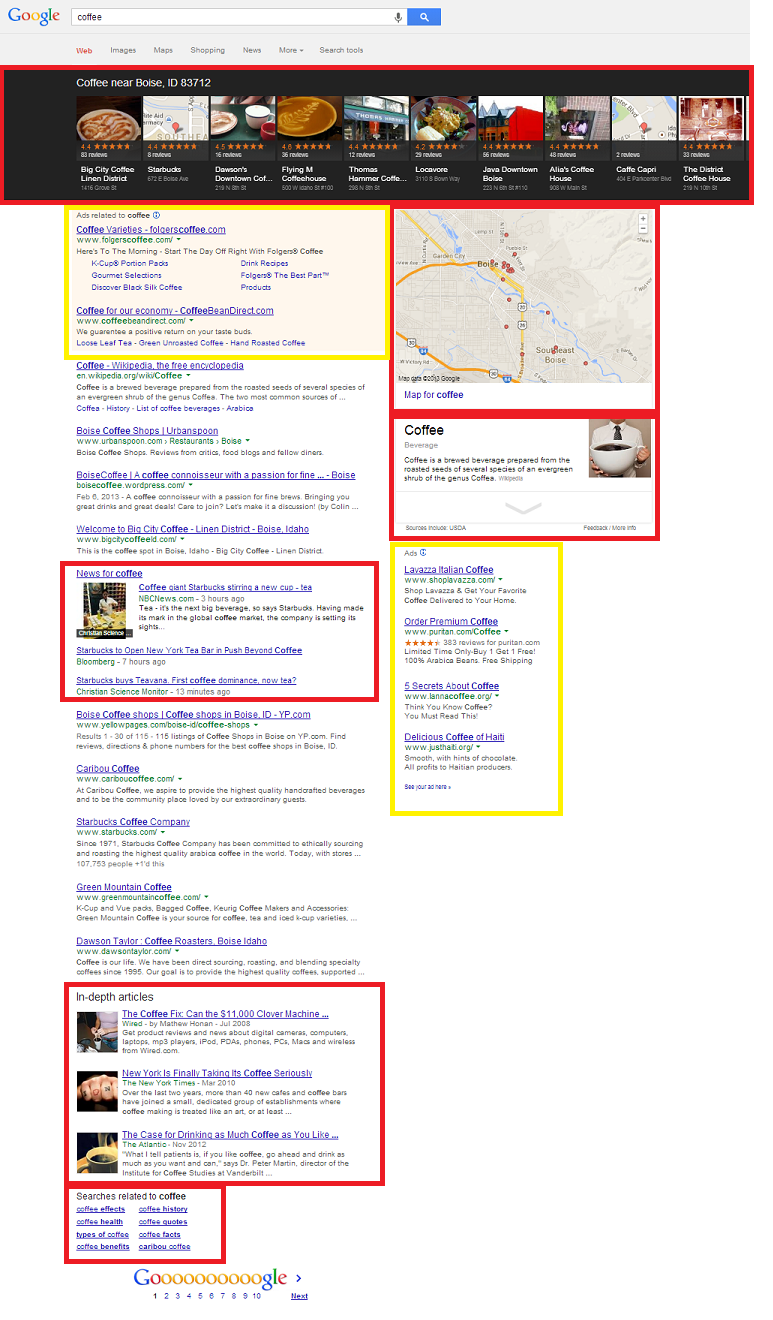
I highlighted ads in yellow and additional Google elements in red. The red represents Google’s attempts at creating an overwhelmingly great user experience. The yellow represents their profits.
Anything not highlighted has made it into the results using at least some search engine optimization.
First, take a moment and appreciate just how much Google puts into search quality – there’s a wealth of informational elements designed to satisfy searcher intent, without even having to click away from Google. Secondly, notice how discreet the ads are; the overwhelming majority of people who click on ads in search don’t realize they are, in fact, advertisements.
Now, think about the fact that every other website in that search is employing SEO. Think about what that really means, and the importance of that – Google’s staggering revenue flows from search. SEOs work to put client’s websites at the top of relevant searches. The highly competitive, lucrative search terms are dominated by SEO efforts.
The obvious conclusion is that Google has to care, deeply, about SEOs and their capabilities. Google clearly has a vested interest in keeping SEOs in line – if we’re able to get websites that don’t create great user experiences into their search, we could truly affect their bottom line.
The easiest way to manipulate a website to the top of search is to build manipulative links. Now, this won’t work forever. This is called ‘black hat SEO’, often referred to as ‘churn and burn’, because it will work for a while, then get caught and burned out of the results by Google.
Google works hard to keep their search results clear of these manipulative practices with both manual and algorithmic (think automatic, like Penguin) penalties. These penalties will literally plummet a site out of search, making them all but impossible to find.
These penalties will lasts until the websites stop their manipulative practices and appeal to Google for reconsideration, which can take months to successful repeal. Penalties are typically difficult and expensive to recover from, and result in serious revenue loss.
And Google leaves a lot of grey area on what is and is not acceptable, leaving a lot open to interpretation. There is also a lot of misinformation out there cluttering the web, making it hard for the inexperienced to know what’s true and what isn’t.
This means we have to be extremely careful and considerate in how we approach link building.
So, in summation, link building is hard because:
- Building links from authoritative websites to clients is itself a difficult task, because:
- Authoritative websites understand the power of a link, and the power they hold
- Authoritative websites are constantly barraged with link building efforts, making it hard to cut through the noise
- Google is extremely strict in their judgment of links, and explain in vague or open ended terms which links they’ll punish. Being careless will result in serious consequences.
There’s such an overwhelming amount of money riding on search visibility, and such an overwhelming amount of pressure from Google to not go over the line.
As you can see, link building isn’t a simple matter.
So, we work within Google’s guidelines, helping clients build good links on sites that make sense, which will boost their performance in Google.
There’s a variety of ways we can build these links. Let’s take a look at the how of link building.
How Link Building Works & Examples
The term ‘link building’ is actually counterintuitive, because we’re not in control of making the coded link as the term seems to imply.
We have to convince another website that linking to our client is either beneficial for them or will in some way benefit their visitors.
Have I mentioned that paying for links is completely against Google's rules, and will result in swift and severe penalties?
Ideally the site I’m attempting to build links to is in fact useful, and will provide some measure of value.
Let’s look at a few common examples of how link building works:
1. Building links through resources
One go-to link building strategy is resource creation. In order to ensure I can acquire worthwhile links, my client needs to build a resource real people within their market will find useful. Of course I can help or make recommendations with the resource creation, but it needs to be hosted on their site.
Once the resource is created and the client has it live on their website, I find a variety of websites worth acquiring a link from who already have a list of resources similar to my client’s. I get in touch and ask to be included within that list.
Here’s the simplistic step-by-step process for building resource links:
- Research to find a resource gap/needed resource for the client’s industry
- Further research to ensure interest and link building opportunities
- Resource creation, focusing on user value
- Targeted outreach leveraging the resource’s value in order to obtain quality relevant links that make sense for users.
There’s a few spin-offs of this technique as well, to make the process easier or take a different angle:
- Update an old/dead resource to capture already existing links (found through research)
- Start a fresh outreach campaign with an already existing and under-performing resource
- Find links pointing to similar resources and inform site owners, suggesting client’s resource
- Find broken links in target lists, inform site owners and suggest client’s resource for inclusion while providing valuable information to site owner.
2. Building links through content
Another pervasive link strategy is to create valuable content relevant to the client’s industry. We then contact another website, offering the content for free.
Commonly the content is hosted on the website I’m reaching out to, as opposed to the client’s site. This is somewhat of a barter type situation – I provide valuable content in return for my client being exposed to a new audience along with a link back to their site.
Examples of different content commonly used:
- A post/article for their blog
- An infographic
- An interview
- A tool their visitors will find helpful
- A news piece.
Somewhere within the content will be a link back to my client’s site, either embedded as a resource or as part of the bio to explain to the audience where the content is coming from.
This link building method is used to target high authority websites within the client’s niche. It’s a slower method of link building, but can create truly great links and high visibility.
3. Building links through community value
Another quality link building tactic is building links through community value. Sounds vague, but what it really means is doing something meaningful within the client’s community – online or physical – that will earn the client links and generate conversation.
Typically this takes much more client involvement than other link building strategies.
A few common examples of this are:
- Starting a scholarship
- Hosting/attending a charity event
- Thought leadership – sharing industry news, strategies, guides, videos, etc.
- Host a giveaway/contest
- Building a mutually beneficial partnership with another business/website.
The proper steps are:
- Research the client’s community to find a meaningful way to add value
- Research to ensure interest and link building opportunities
- Follow through
- Outreach to targeted sites in order to build good links that make sense.
This is typically an even longer term strategy than content creation. Oftentimes we’re actually brought in when a client already has something of this nature planned, and is looking to further capitalize on the value of what they’re doing.
The goal here is to help the client do something notable, then help create a buzz within their community, securing links as possible.
Recap
As link builders it’s our job to secure links from relevant sites back to our client’s website. We can’t actually create the link – we have to rely upon whatever assets the client has, along with our natural powers of persuasion.
There are various strategies we can use to help leverage this process. These include using the client’s resources, providing further content, leveraging relationships, and highlighting the value of the client’s site and brand.
Ideally we create links that are useful for:
- The client
- The website linking
- That website’s users/visitors.
This keeps the links from being flagged as manipulative by Google, and keep them safe from any future updates by Google.
Creating these links will help our client’s visibility within Google search. They’ll appear in more searches relevant to the client’s industry. This is because Google created search around the concept of links as votes of confidence: the more relevant links a website has, the more important Google believes them to be within their industry.
There’s many other factors within SEO, but links still remain very integral to any SEO strategy.
Link building is difficult because Google fiercely protects their search quality – advertising within search results is how they make 95% of all revenue.
If we use manipulative practices, or build low quality links, the client will suffer. Therefore we work extremely hard to be careful we’re only building good links on sites that make sense, in a natural, non-manipulative manner.
The reason I love link building is because it’s both a science and an art: it requires technical knowledge and analytical skills, but the best link building tool in the world is human creativity.