
Digital PR

Most of what’s been written about AI and search over the last two years is a coin flip dressed up as strategy.
Will AI replace Google? Nobody knows. It’s a great panel question and a terrible planning input, because whatever you decide, you still have to go do something on Monday. And “prepare for a future that may or may not arrive” is not a something.
So we asked a question with an actual answer. Not whether AI will replace search, but what a real person does in the ninety seconds after an AI assistant hands them a product name.
We surveyed 1,000 US adults. Here’s what we found, and here’s the part that should change your target list.
The setup: adoption is real, primacy isn’t
65% of respondents have used an AI assistant to research a purchase in the past three months. That’s a genuinely big number and it’s the one that gets quoted.
But only 12% say an AI assistant is where they begin product research. Google still owns 42% of first moves. Amazon and other retailers take 27%.
Two thirds have been there. One in eight starts there. If you’ve seen a chart claiming AI has taken over product discovery, somebody probably conflated those two questions, because collapsing them makes for a much more exciting slide.
The finding: the AI answer is a starting gun
We asked the 653 respondents who’ve actually used AI for product research what they do once it recommends something specific.
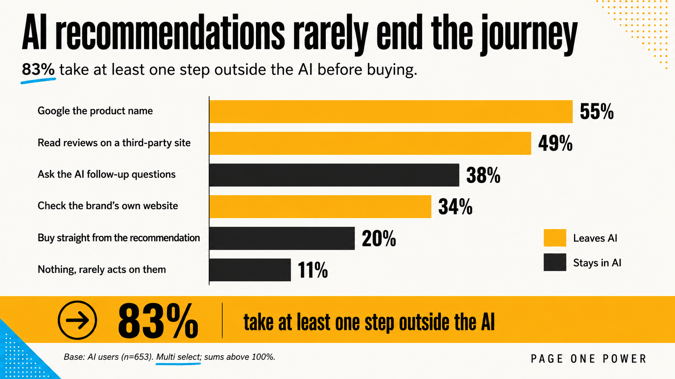
83% take at least one verification step outside the AI. Over half go Google the product name. Half go read reviews on a site that isn’t the AI and isn’t the brand. A third go straight to the brand’s own pages.
One in five buys directly off the recommendation. That’s the whole “AI is going to eat your funnel” scenario, and it’s a fifth of a subset.
The finding under the finding
I assumed this was generational. Older shoppers don’t trust the robot, younger ones will, and once today’s 18 to 24s are the whole market the verification trip quietly dies.
Wrong, and not by a little.
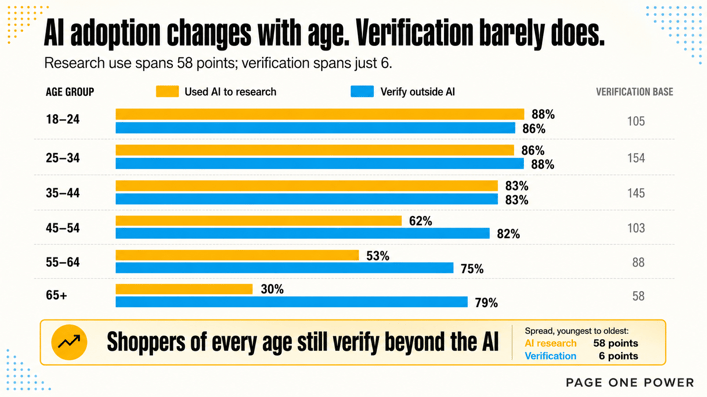
Adoption falls 58 points from the youngest group to the oldest. Verification falls six.
Under-25s reach for AI constantly and trust it exactly as far as their grandparents do once it names a product. This habit isn’t going to age out of your market, because it was never about age. It’s about spending money on something you can’t return easily.
Which the next chart makes fairly obvious.
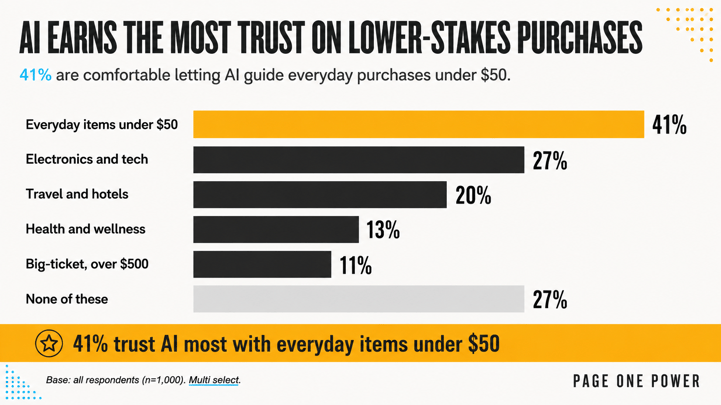
41% will let AI guide a sub-$50 purchase. 11% will let it guide something over $500. AI has earned the toothpaste decision. It has not earned the mattress.
What to actually do with this
Four things, in the order I’d do them.
1. Add verification surfaces to your target list
Half of AI users go read third-party reviews after a recommendation. Those destinations are category roundups, comparison posts, and review sites, and most link building target lists are still sorted by domain authority rather than by whether a real buyer in your category would land there mid-decision.
Do this: sort your prospect list by “would a verifying buyer read this,” then by DR. Not the other way around.
2. Audit your brand SERP like it’s a landing page
55% of AI users Google the product name after the recommendation. That query is the single highest-intent search in the entire journey, and it’s one you don’t control and probably don’t track. Go run it. If the first page is a stale forum thread and two competitor comparison posts, that’s your conversion problem.
Do this: search “[your brand] [product]” and “[product] review” right now. Screenshot it. That’s the moment of truth.
3. Weight editorial coverage toward high-consideration SKUs
Comfort with AI guidance collapses as price rises, which means verification intensity climbs as price rises. Your expensive products are the ones where third-party validation carries the most weight, and they’re usually the ones with the thinnest editorial footprint because they’re harder to write about.
Do this: map your editorial coverage against revenue per SKU. Look for the expensive products nobody’s written about.
4. Stop measuring AI visibility on its own
Getting cited in an AI answer is worth real money, but Chart 1 says a citation buys you a spot on a shortlist, not a sale. If you’re tracking AI citations without tracking what a verifying buyer finds afterward, you’re measuring the first half of a two-half process.
Do this: pair every AI visibility report with a brand SERP audit. One number is meaningless without the other.
Why this is the two currencies argument
We talk about links paying in two currencies: rankings and AI citations. This survey is the receipt for both, on the same shopping trip.
The AI citation gets your product onto the shortlist. The rankings and the earned editorial coverage are what survive the verification trip that 83% of those shoppers take next. Same asset, spent twice, ninety seconds apart.
The AI didn’t create a new place for buyers to go. It added a step that sends them to the same places, with sharper intent than they had before, because now they have a product name and a specific doubt about it.
What this survey can’t tell you
We didn’t ask what happened after verification, so we can’t claim the second opinion changes the decision. It may be a ritual people perform on the way to a choice they already made.
We didn’t measure effort. “Verified” covers a thirty-second glance and a three-evening research bender.
And the window was three months. AI shopping habits are visibly still forming, so treat this as a snapshot rather than a trend line.
But four out of five people leave the chat window before they spend money, and they leave specifically to find somebody else’s opinion.
Being the second opinion is the job. It was the job before any of this. The only thing that changed is how many people are now making the trip.
Method
1,000 US adults 18+, fielded July 21-29, 2026, age-weighted to the US adult population. Post-recommendation questions were asked only of respondents who reported using an AI assistant for product research (n=653) and use that base throughout. Multi-select questions sum above 100%. Age-group verification cells range from n=58 to n=154; the 65+ cell is directional only.