Advanced SEO

Every SEO on earth has now had this meeting. You walk in with a chart of keyword positions that goes up and to the right. Rankings improved. Average position improved. You gained three featured snippets. Then somebody opens Analytics and sessions are down 18% year over year and the room goes quiet and someone says the word "attribution" and you all pretend that helped.
I've been in that meeting more times than I'd like to admit. So we did what any reasonable agency does when it gets tired of guessing: we asked actual people what they're doing.
Not SEOs. We know what SEOs think. SEOs think Google is stealing from them, and SEOs have been saying that continuously since roughly 2011, which makes it hard to tell what's new. We asked 1,000 regular Americans about the last time they Googled a quick question.
The answer is worse than "Google is stealing your traffic." The answer is that your readers have quietly decided you're not worth the round trip.
Takeaway 1: They know it's wrong. They've stopped checking anyway.
Here's the finding that made us sit up.
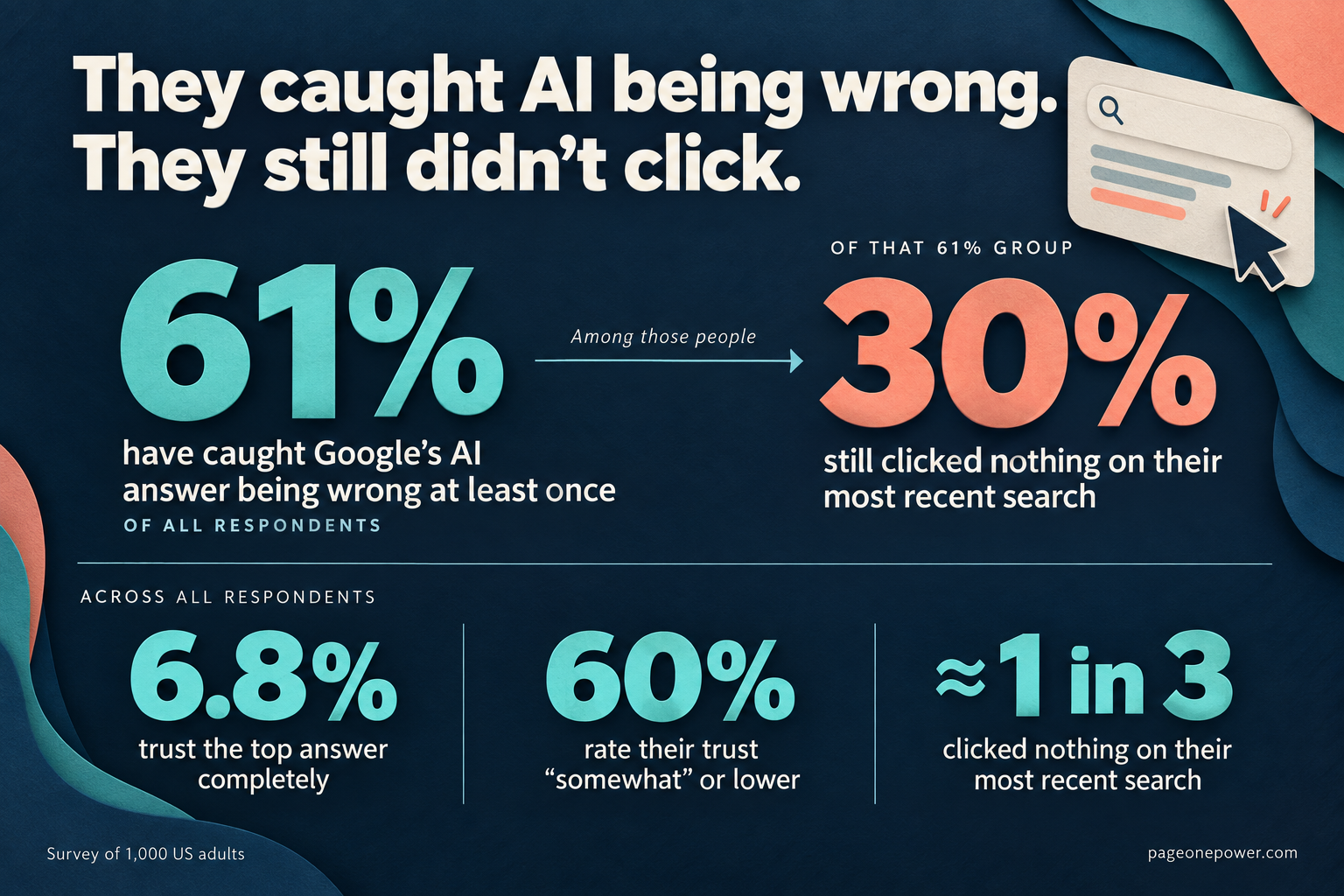
61% of people have caught the AI answer at the top of Google being wrong at least once. Not "worry it might be wrong." Caught it. Watched it confidently tell them something false.
Of those people, 30% still clicked nothing on their most recent search.
Read that twice. Nearly a third of the people who have personally watched this thing lie to them did not bother to verify the next answer it gave them. Only 6.8% of respondents say they trust the top answer completely, and 60% land at "somewhat" or lower. And a third of everyone still clicked absolutely nothing.
This is the part the industry keeps getting wrong. We keep framing this as a quality fight, like the answer box beat us because it got good. It didn't get good. It got convenient, and convenient is undefeated. Your content can be more accurate, more current, more expert, and more E-E-A-T-compliant than the summary at the top of the page, and it will still lose, because your content requires a tap and the summary does not.
You are not competing on accuracy. You stopped competing on accuracy a while ago. You're competing against a thing that requires zero effort, and you are three seconds of load time away.
Takeaway 2: Half of this is our own fault
Now the uncomfortable one.
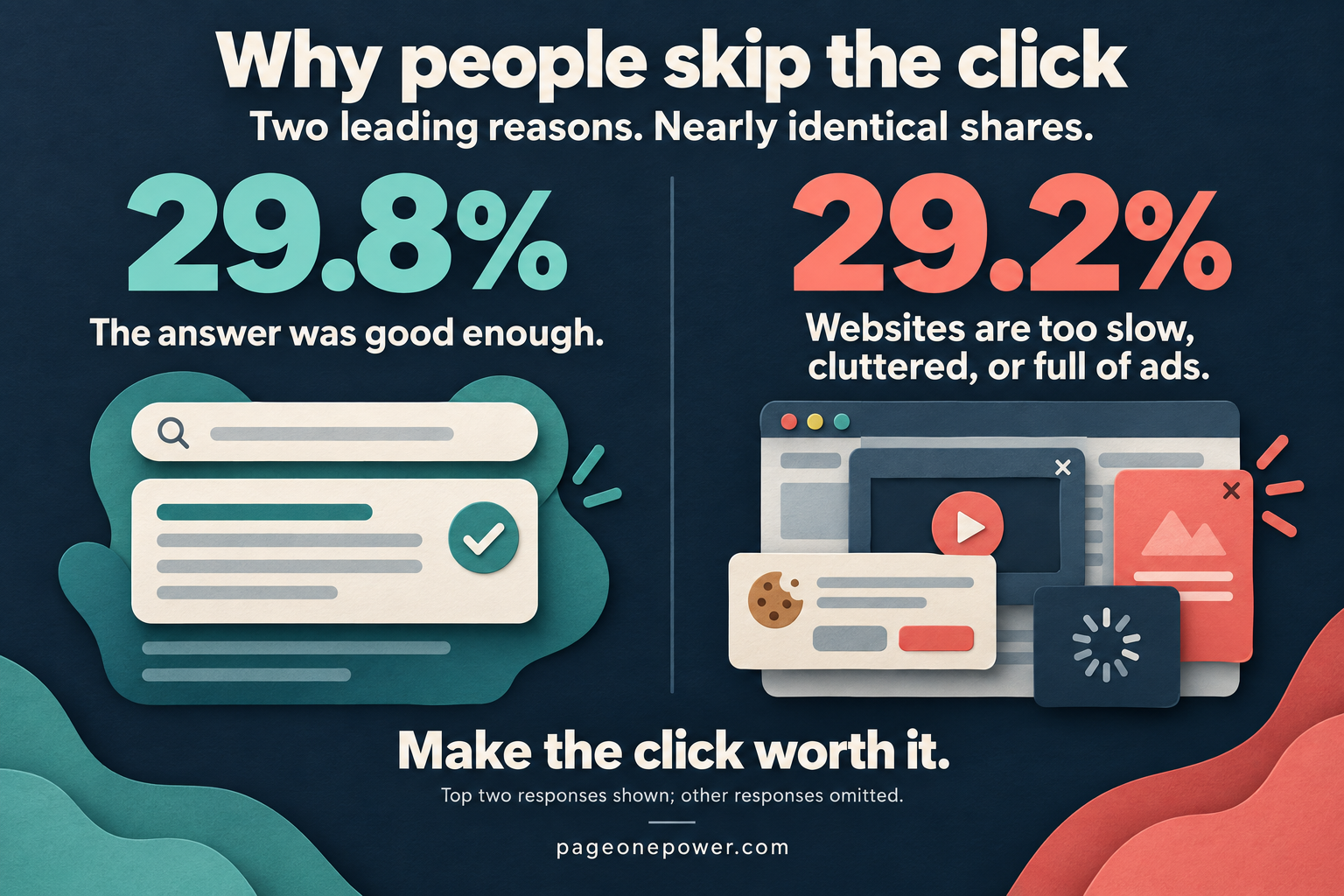
We asked people why they skip the click. The two top answers came in at a statistical dead heat:
- 29.8% said the answer was good enough.
- 29.2% said websites are too slow, cluttered, or full of ads.
That's a tie inside the margin of error. Which means roughly half of the traffic exodus has nothing to do with AI at all. Half of it is people who would happily click a website if clicking a website weren't an ordeal.
You know exactly the experience they're describing. You click a result for "how long to boil an egg." You get 1,400 words about the author's grandmother in Sicily. A video autoplays. A newsletter modal slides in from the left. A sticky footer ad covers the answer. The page reflows twice while you're reading. You bounce back to the results page and take Google's word for it, and honestly, good for you.
We built that. Not Google. Us. Every publisher who bolted a fifth ad unit onto a page that already had four, every SEO who padded a 200-word answer to 1,800 words because a tool said the top ten averaged 1,800 words. We spent fifteen years making the click worse and then acted shocked when a competitor showed up offering no click at all.
Rankings up, traffic down. Some of that is the answer box. Some of that is the page you're sending people to.
Takeaway 3: There's still a floor, and you should be standing on it
Okay, enough doom. The survey found a very clear line between what people will still click for and what they won't.
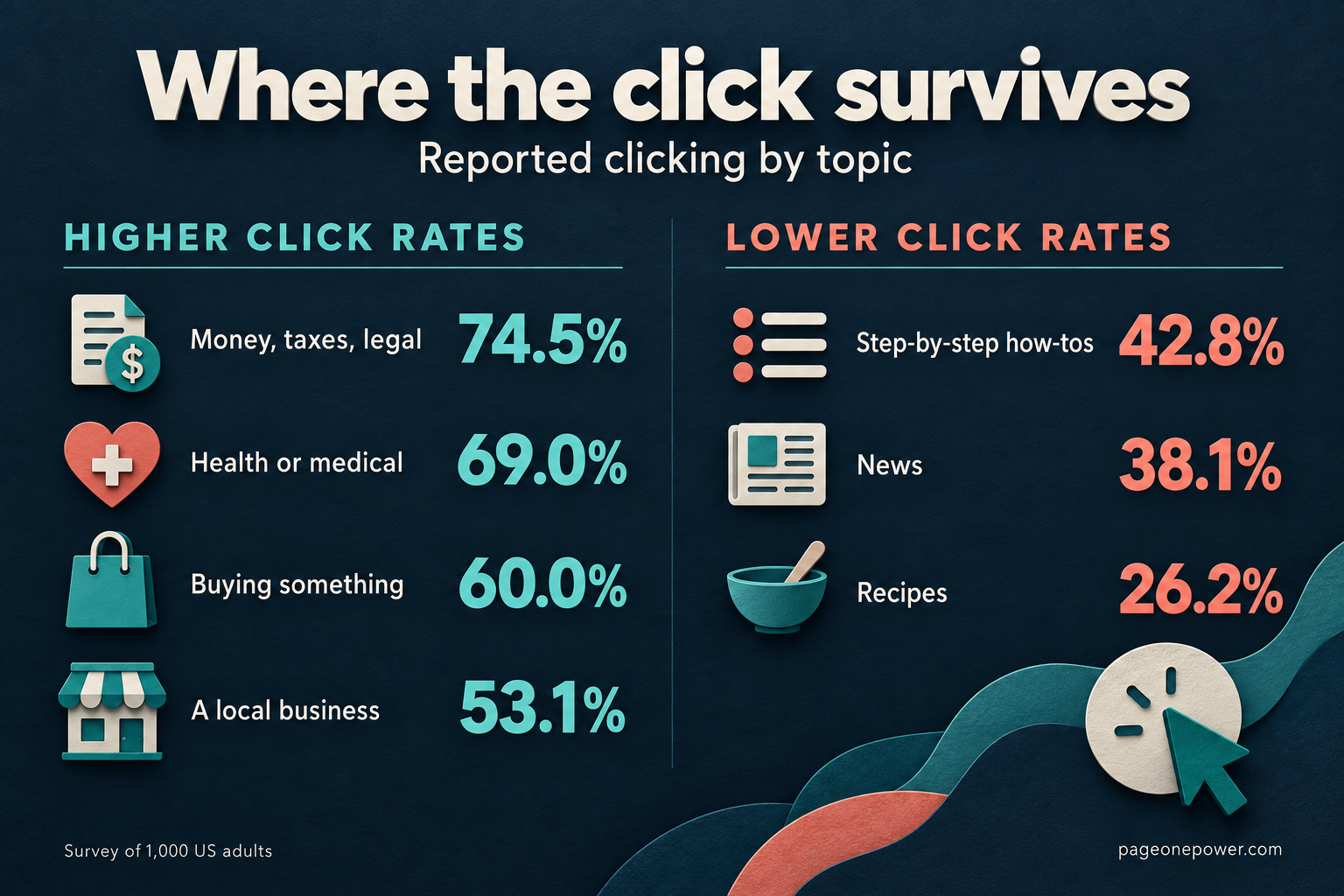
Still clicking:
- Money, taxes, legal: 74.5%
- Health or medical: 69.0%
- Buying something: 60.0%
- A local business: 53.1%
Basically gone:
- Step-by-step how-tos: 42.8%
- News: 38.1%
- Recipes: 26.2%
That's the whole strategy in one list. When the answer carries real consequence, people want a human institution behind it. They want a name on it. When the stakes are "I need to know the oven temperature," they'll take whatever's on the screen.
If your content strategy is built on informational how-to content that resolves in a paragraph, that traffic is not coming back and no amount of ranking improvement will bring it back. Rankings up, traffic down, forever, on those terms.
And the generational data says the floor is still sinking. 42.5% of 18 to 29 year olds clicked nothing on their last search, versus 26.2% of people over 60. On every single category, younger searchers click 20 to 26 points less than older ones. Whatever your zero-click problem looks like now, it looks like the 18 to 29 column in about a decade.
So what do you actually do
Three things, and none of them are "make better content," because you're already trying that.
Move up the consequence ladder. Stop optimizing for questions that resolve in a sentence. Put your effort where a wrong answer costs the reader something: money, health, a purchase decision, a local commitment. That's where the click survives.
Fix the page. Half your defectors said the website experience is why they left. That's the cheapest fix on this list and the one nobody wants to do, because it means removing revenue units and cutting word count that a content brief told you to add.
Get cited, not just ranked. If a third of searches end at the summary, then being inside the summary with your brand name attached is the impression. It's worse than a click. It's not nothing. And it's earned the same way it's always been earned: real publications citing you, which is the entire reason we still do link building for a living.
Rankings up, traffic down. It's not a measurement error, and it's not entirely Google's doing. Some of it is a machine that's convenient enough to beat you even when it's wrong. Some of it is that you made the click cost too much.
Only one of those two is in your control. Start there.
Methodology: n=1,000 US adults, nationally representative by age, gender, and region. Fielded Aug 2nd 2026 . Margin of error ±3.1 percentage points at 95% confidence.