AIO

From a headline about ChatGPT several years ago to today, we as marketers have been trying to predict and will always try to predict how consumers are going to interact with search results. From a logical standpoint, I believe that most marketers believe that a majority of consumers are clicking the sources in AI answers. What our study discovered was that fewer than 1 in 4 actually do. But consumers trust the brands AI names far more than marketers realize.
Budget season is here, and "AI visibility" is showing up as a line item in a lot of 2027 plans. To find out whether those plans match reality, Page One Power surveyed 1,000 U.S. consumers and 300 U.S. marketing decision-makers with the same questions about AI search.
The short version: marketers are overrating the click and underrating the mention.
Key findings
- Marketers estimate 52% of consumers click a source in AI answers. Only 23% of consumers say they did the last time they saw one.
- 64% of consumers trust a brand recommended by AI more than one they saw in an ad. Marketers think only 41% do.
- 71% of marketers say they have an AI visibility strategy. Just 19% measure it.
- 37% of marketers don't know which websites AI tools cite most in their category.
- 44% of consumers say an AI tool has recommended a product or business that was wrong, outdated, or not real.
- 29% of consumers can't tell when AI answers include sponsored content.
What marketers think vs. what consumers do
The gap runs in two directions.
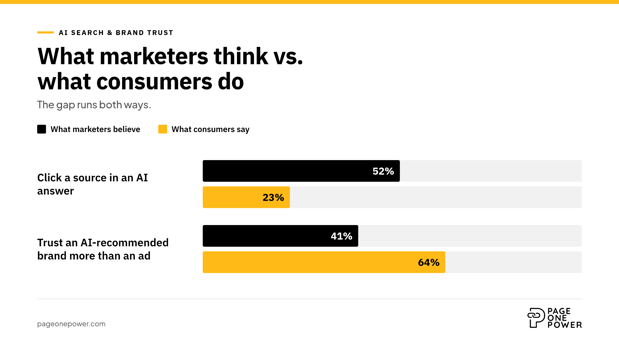
Marketers expect AI answers to behave like search results that send traffic. Consumers treat them more like a recommendation from a knowledgeable friend: they take the name, then go check it out on their own. 41% of consumers who saw an AI name a brand went to Reddit, forums, or review sites next.
That changes what winning in AI search means. The click is a bonus. Being named is the main event.
Most marketers have an AI strategy. Few know if it works.
71% of marketers say they have a strategy for showing up in AI answers. Only 19% measure whether it's working. That leaves 52% of marketers running an AI visibility plan with no way to tell if it's doing anything.
Part of the gap is how loosely "strategy" gets used. Fewer than half of those with a strategy (31% of all marketers) have it written down. The rest describe something informal, like publishing content with AI in mind and hoping it gets picked up.
A strategy you can't measure is hard to defend at the next budget review. Before adding spend, marketers need a baseline: which prompts in their category mention them, which competitors get named instead, and which sources AI pulls from.
Marketers are spending ahead of their measurement
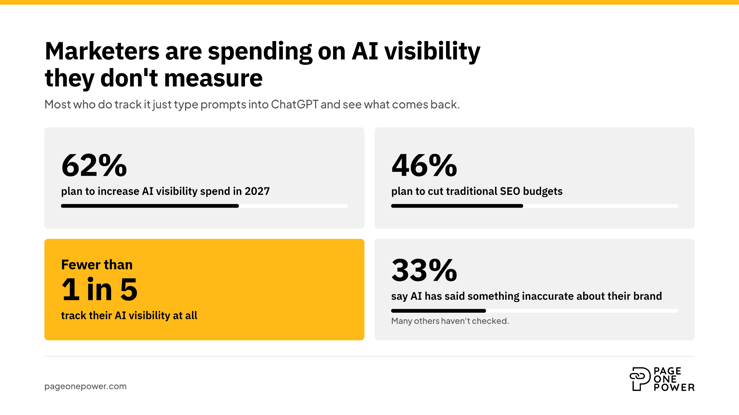
62% of marketers plan to increase AI visibility spend in 2027, and 46% plan to cut traditional SEO budgets. But fewer than 1 in 5 track their AI visibility at all. Most who do check it by typing prompts into ChatGPT and seeing what comes back.
One in three marketers (33%) say AI has said something inaccurate about their brand. Many others haven't checked.
Marketers may be looking in the wrong place
Asked what most influences which brands AI recommends, 44% of marketers picked their own website content. Only 18% picked mentions and links on other websites, and 9% picked Reddit and forums.
AI tools build answers from what the rest of the internet says about you, not just what you say about yourself. Marketers who only optimize their own site are working half the problem.
AI gets it wrong, and consumers notice
44% of consumers say an AI tool has recommended a product or business that turned out to be wrong, outdated, or not real. A closed store, a discontinued product, or a company that doesn't exist, delivered with the same confidence as a correct answer.
AI fills gaps with whatever it can find. Brands with few current, credible mentions around the web leave more room for AI to guess, describe them inaccurately, or recommend a competitor it knows more about.
It also explains why consumers double-check. They've learned AI can be wrong, so they verify on review sites and forums. Brands that show up consistently in those places hold up under the check. Brands that don't can lose the sale at the last step.
Sponsored or organic? Many consumers can't tell
29% of consumers say they can't tell when an AI answer includes sponsored content. As more AI tools experiment with advertising, the line between a paid placement and an earned recommendation is getting harder to see.
That matters for the trust numbers. 64% of consumers trust AI-recommended brands more than ads, and that trust rests on the idea that AI answers are neutral. If consumers start to suspect recommendations are bought, the value of an AI mention could drop with it.
For now, earned mentions carry the credibility. Brands that get named because other websites vouch for them, not because they paid, are building visibility that should hold up if consumers get more skeptical.
What this means for 2027 plans
Instead of driving direct website traffic, a successful AI search strategy prioritizes building overall brand visibility and earned mentions. Because consumer action relies heavily on AI recommendations that favor companies with strong external web validation, winning in AI search is fundamentally an earned media challenge rather than an on-site optimization project.
For teams finalizing budgets:
- Measure before you spend. Track which prompts in your category mention you, and which sources get cited.
- Find the sites AI trusts in your space. Then work out how to be mentioned there.
- Don't zero out SEO. The sources AI cites are often the same pages that rank well in traditional search.
- Watch what AI says about you. One in three brands has already been misrepresented.
Methodology
Page One Power conducted two surveys via Pollfish in October 2026: 1,000 U.S. adults 18+ and 300 U.S. marketing decision-makers (manager level or above, involved in budget decisions). Respondents who failed an attention check were removed. Percentages may not sum to 100 due to rounding.
Media are welcome to use these findings with a link to this page.