Media/News

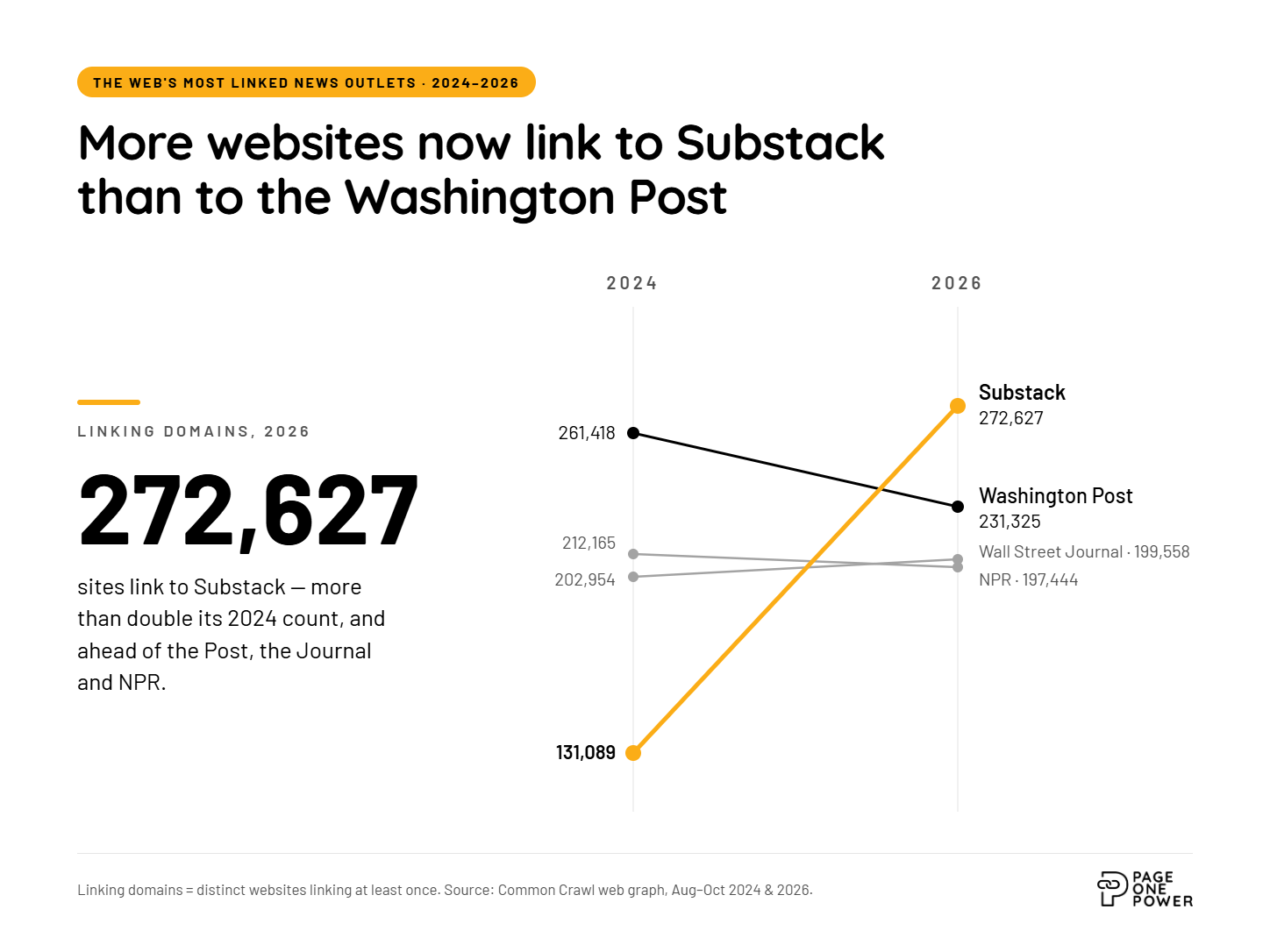
Two years ago, the Washington Post was linked to by twice as many websites as Substack. Today, Substack is ahead of the Post, the Wall Street Journal and NPR.
That reversal comes from an analysis of Common Crawl's open map of the links between 135 million domains. Between late 2024 and late 2026, the typical website lost about 13% of the sites linking to it, and the typical U.S. news outlet in the study lost about 17%. Over the same period, the number of sites linking to ChatGPT rose more than sixfold, enough to place it ahead of Fox News and Newsweek if it were a news outlet.
Key findings
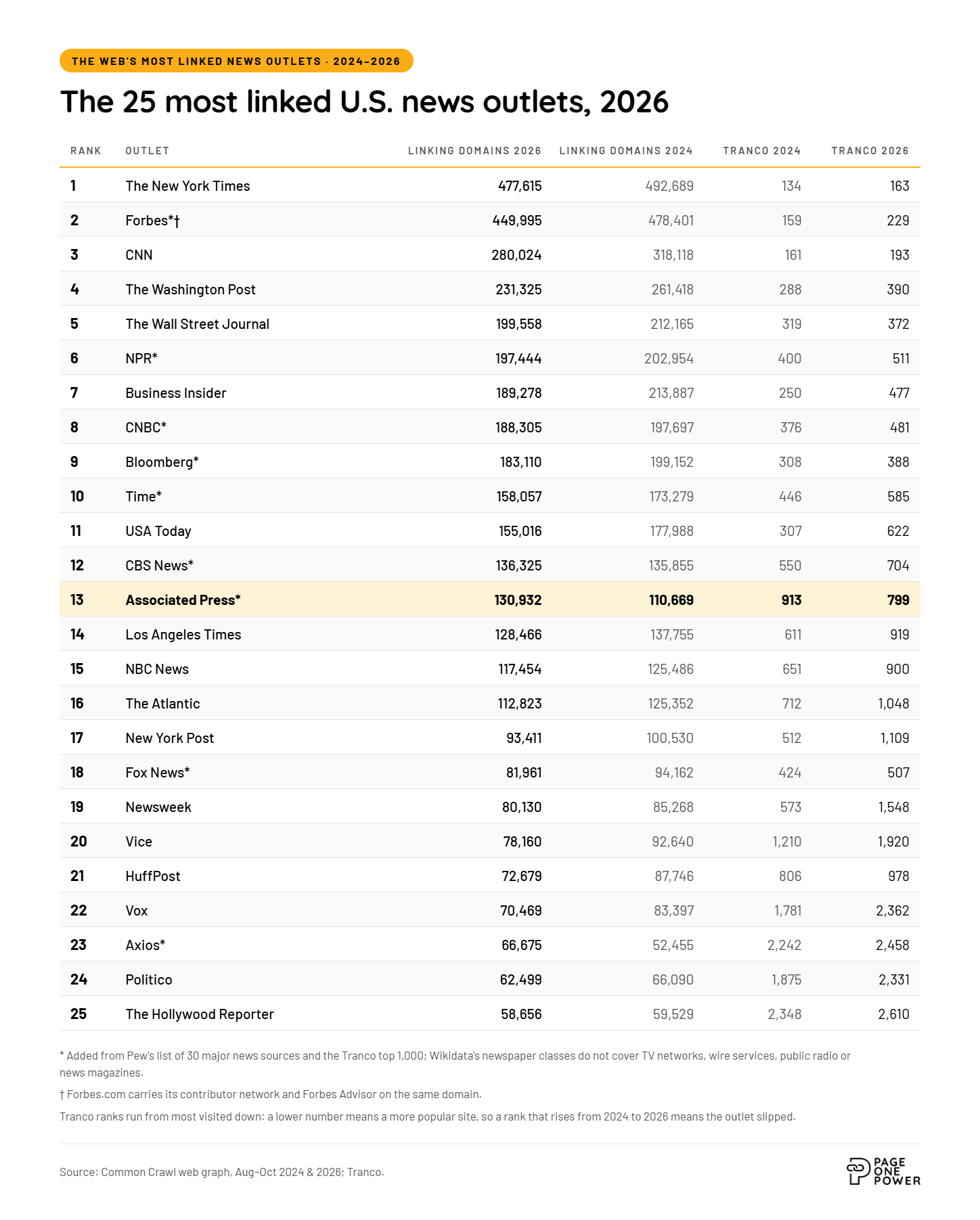
- Substack is linked to by 272,627 domains in 2026, up from 131,089 in 2024, ahead of the Washington Post (231,325), the Wall Street Journal (199,558) and NPR (197,444).
- The number of sites linking to ChatGPT rose from 14,521 to 94,085, a more than sixfold increase that would place it 17th on the 2026 news list.
- The typical website lost 13% of its linking domains over the two years; the typical U.S. news outlet in the study lost 17%.
- 2,019 of the 2,542 outlets with counts in both years (79%) lost linking domains.
- Outlets with 100,000+ linking domains held up better than the web benchmark (median -7% against -9% for sites that size); outlets in the 1,000 to 10,000 band fell behind it (-17% against -13%).
- Only 94 of 768 outlets with at least 1,000 linking domains in 2024 gained any, led by newer independents such as Semafor, The Free Press and Rest of World.
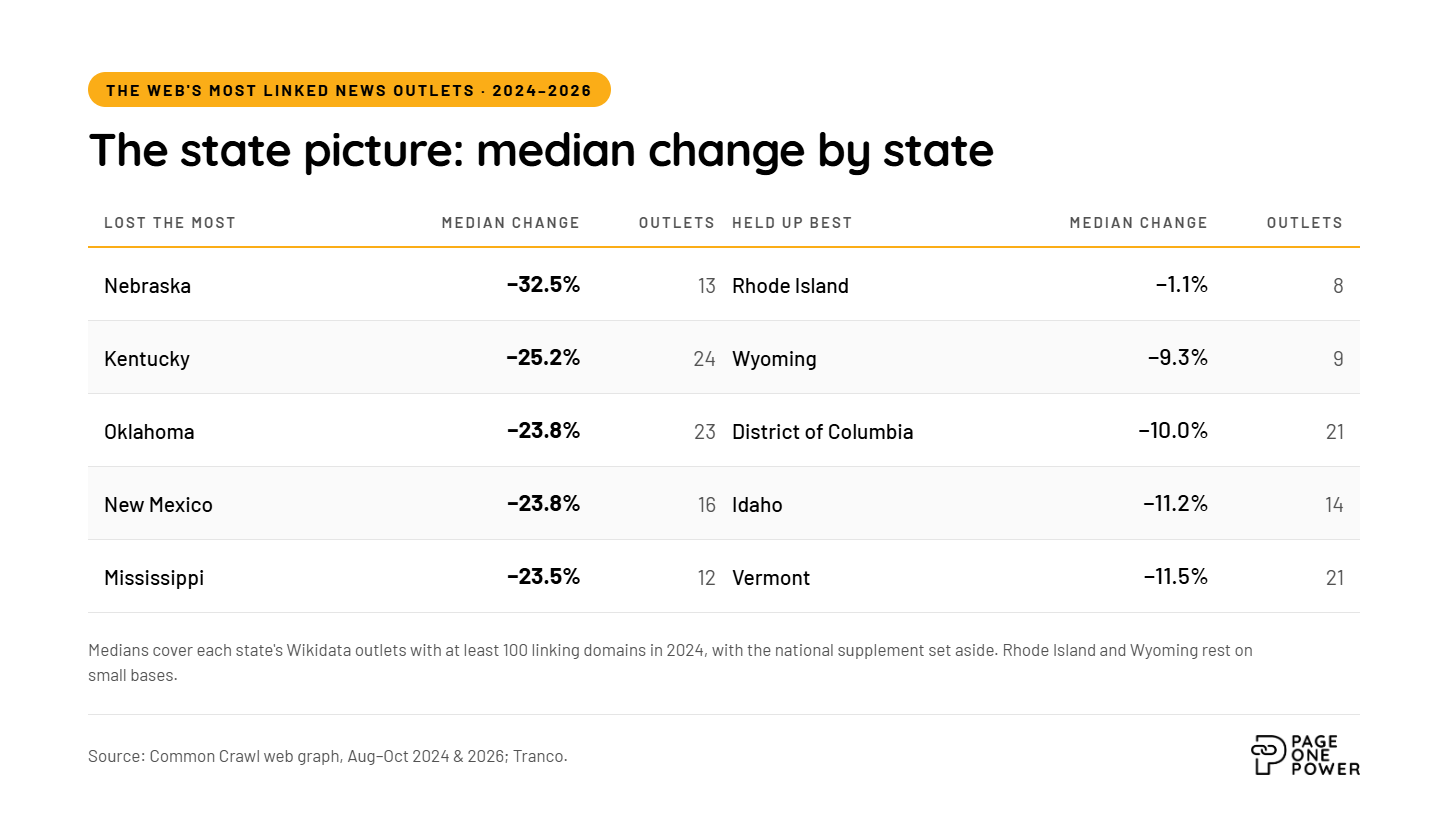
- News outlets based in every state lost links: medians run from -1% in Rhode Island (8 outlets, a small base) to -33% in Nebraska (13 outlets).
The whole web lost links, but news lost more
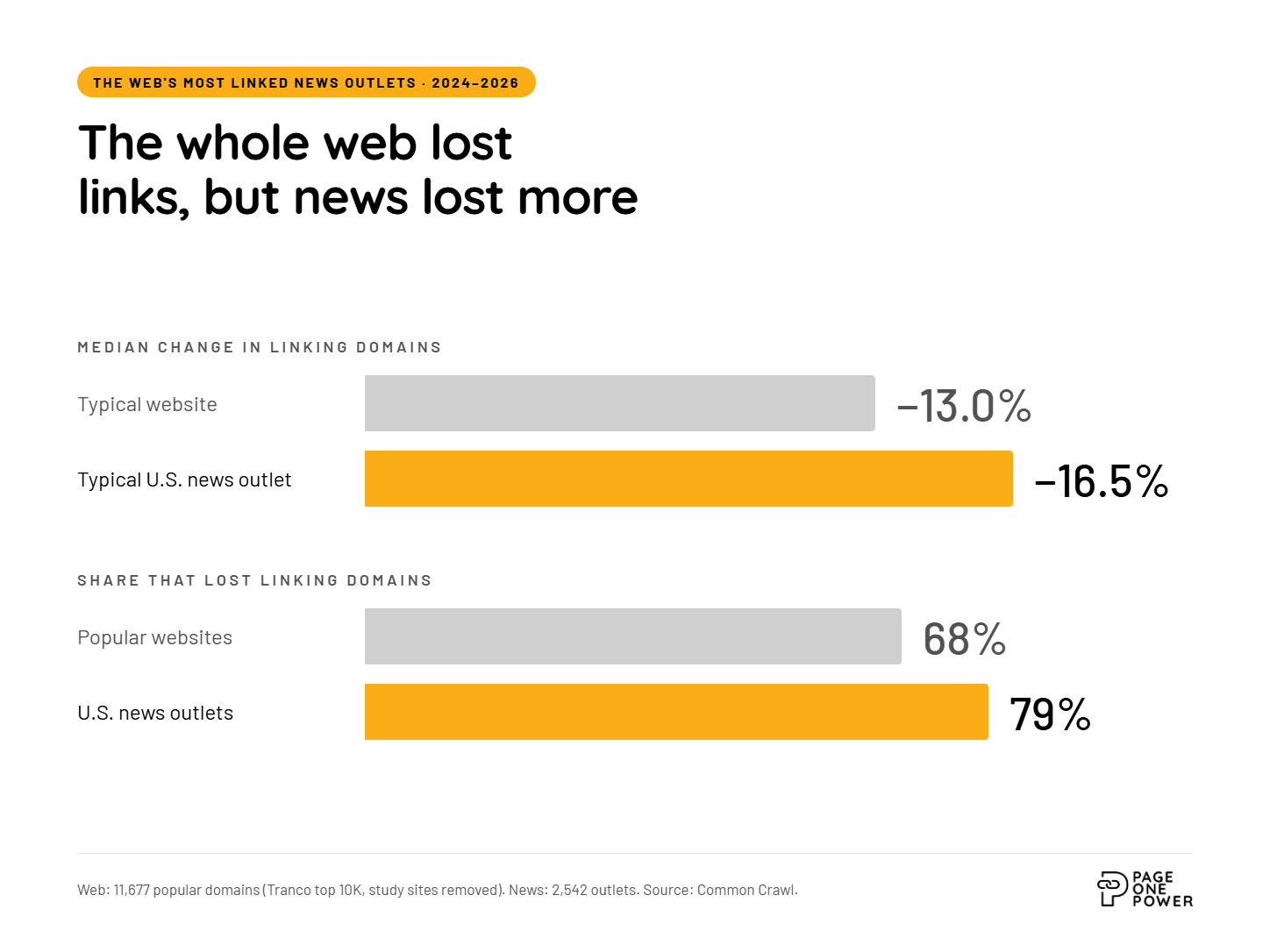
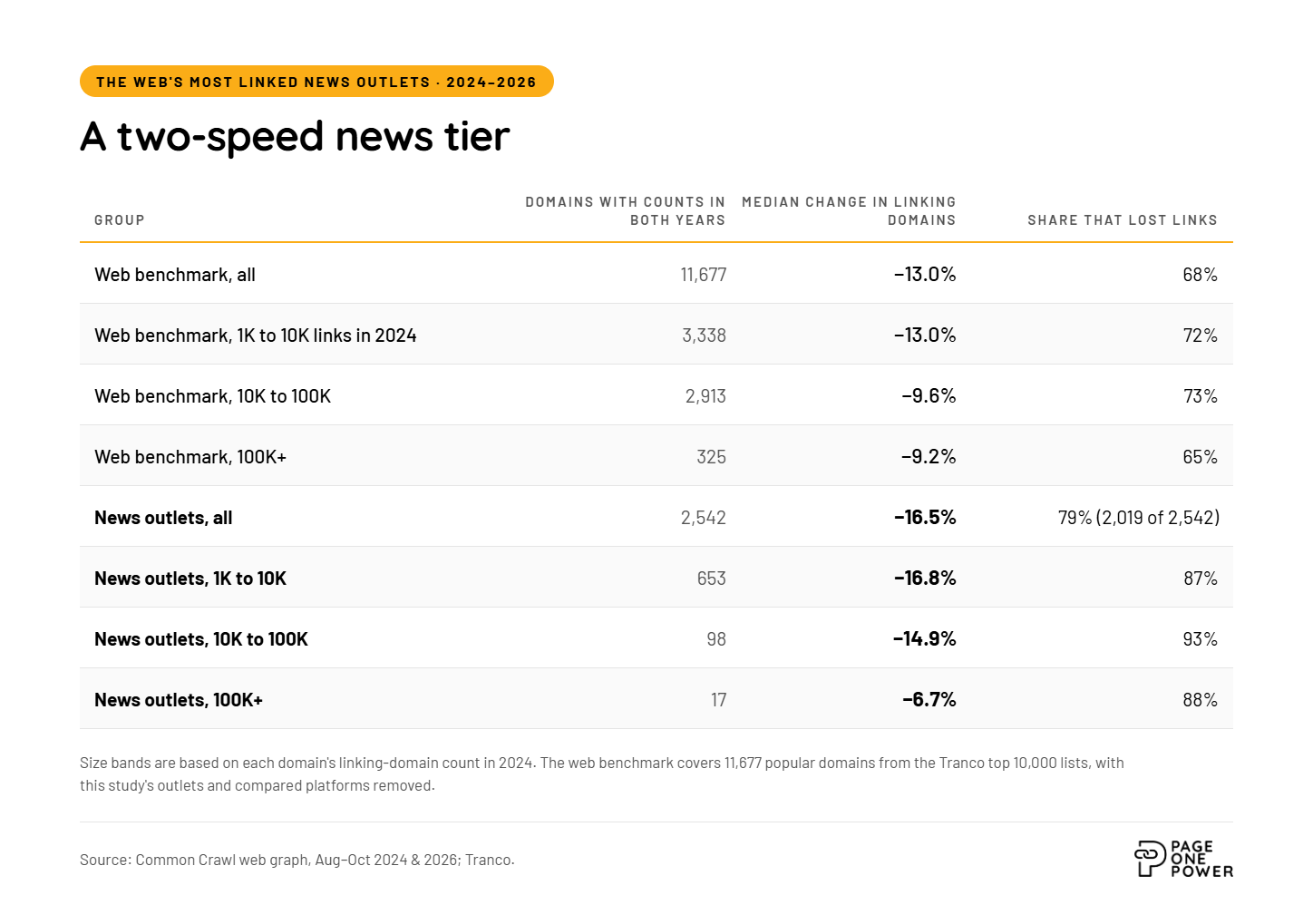
The backdrop matters before any single outlet does. Common Crawl's August to October 2026 release indexed more domains than its 2024 release but found fewer links per domain, so most sites ended the two years with fewer linking domains. Across 11,677 of the web's most popular domains, drawn from the Tranco top 10,000 of 2024, 2025 and 2026 with this study's outlets and the compared platforms removed, the median change was -13.0%, and 68% lost ground.
The 2,542 outlets in the study with counts in both years fared worse. Their median change was -16.5%, and 2,019 of them (79%) lost linking domains. A falling count is the web's new normal. Falling faster than the web is the news-specific story, and it is why every change in this article sits next to that benchmark.
The decline in links runs alongside a decline in readership, measured separately: Medill's 2026 State of Local News report, released in October, found web traffic to the 100 largest local newspaper sites fell by nearly half since 2022, based on Comscore data.
Who the web links to most
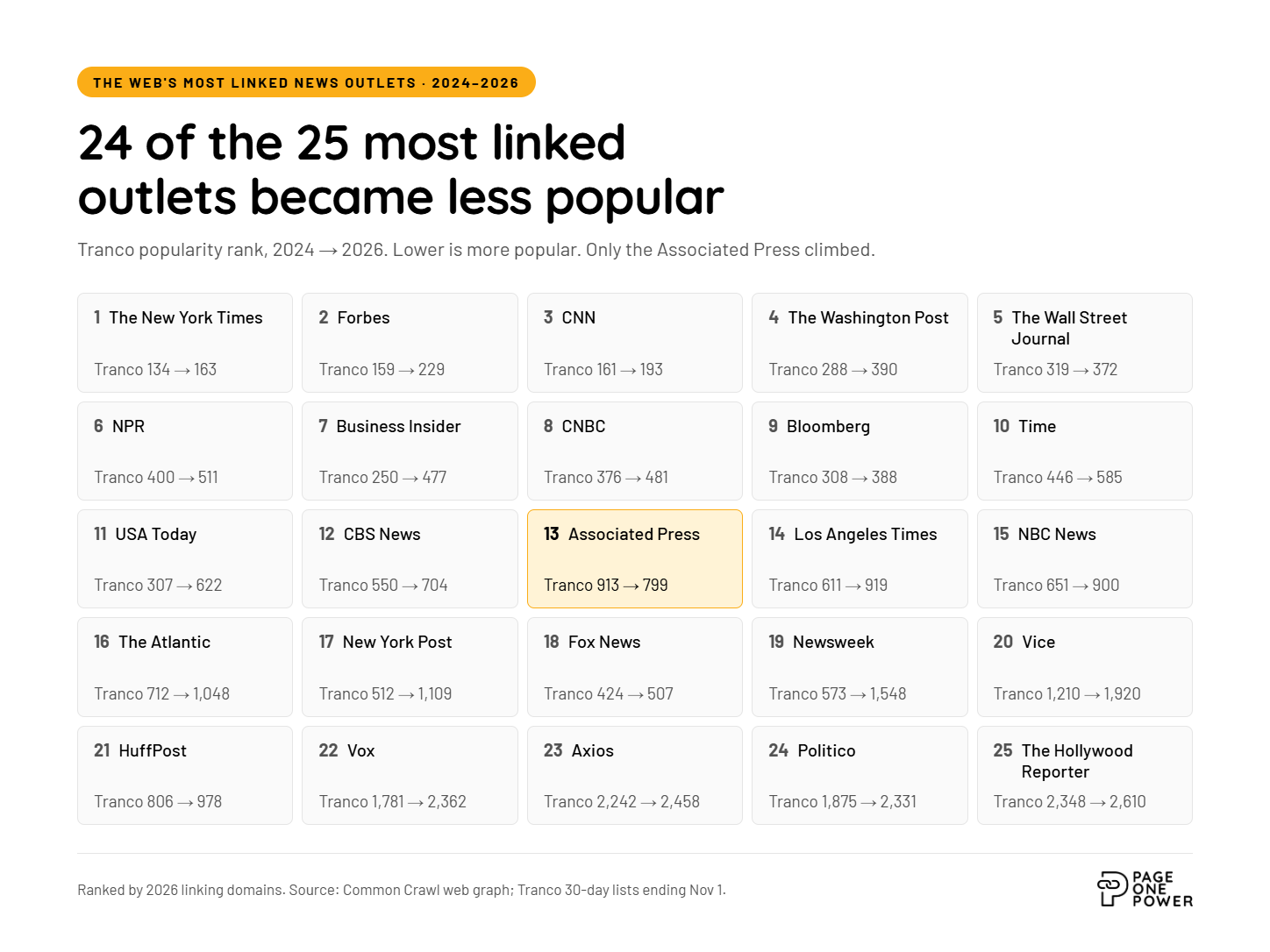
The New York Times leads the 2026 list with 477,615 linking domains, and the top of the list still looks like a national newsstand. The more telling column is popularity. Measured by Tranco, a research ranking of the most visited websites in which a lower number means a more popular site, 24 of the 25 most linked outlets were less popular in 2026 than in 2024.
The Associated Press is the exception, and it stands out twice: among the top 25, it alone both gained linking domains (110,669 to 130,932, against a web-wide median of -13%) and climbed in Tranco, from 913 to 799. Across the 1,523 outlets in the study ranked by Tranco in both years, 1,282 (84%) fell. The steepest slides in the top 25 belong to Newsweek (573 to 1,548), USA Today (307 to 622) and the New York Post (512 to 1,109).
The platforms, side by side
In 2024, the Washington Post was linked to by 261,418 domains and Substack by 131,089, a two-to-one gap. In 2026, Substack sits at 272,627 and the Post at 231,325. If Substack were on the news list, that count would place it 4th, behind only the Times, Forbes and CNN. OpenAI's main domain would place 7th. ChatGPT, which 14,521 domains linked to in 2024, is now linked to by 94,085, which would place it 17th, ahead of Fox News and Newsweek. Claude and Anthropic would each place 25th on their own, just behind Politico, and Perplexity 29th.
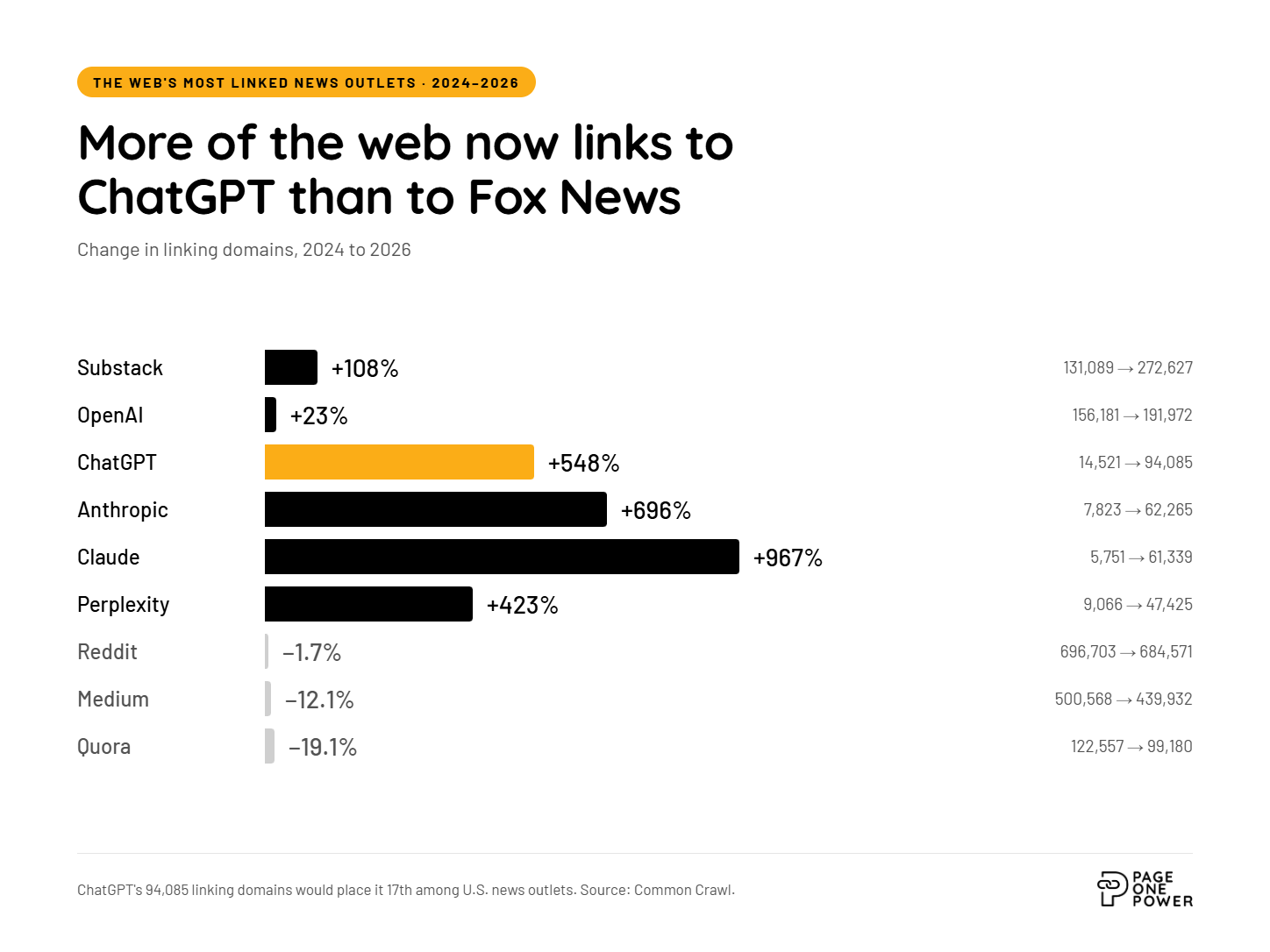
The community platforms tell the other half of the story. Reddit held roughly steady, Medium fell about in line with the web and Quora fell faster. None of the three gained, so the growth runs to AI platforms and Substack rather than to forums. One disclosure belongs here: Substack and Medium aggregate thousands of writers on one domain, and many links to ChatGPT are shared conversations rather than references. This study measures where the web points its links. It says nothing about what those linking sites trust or rely on.
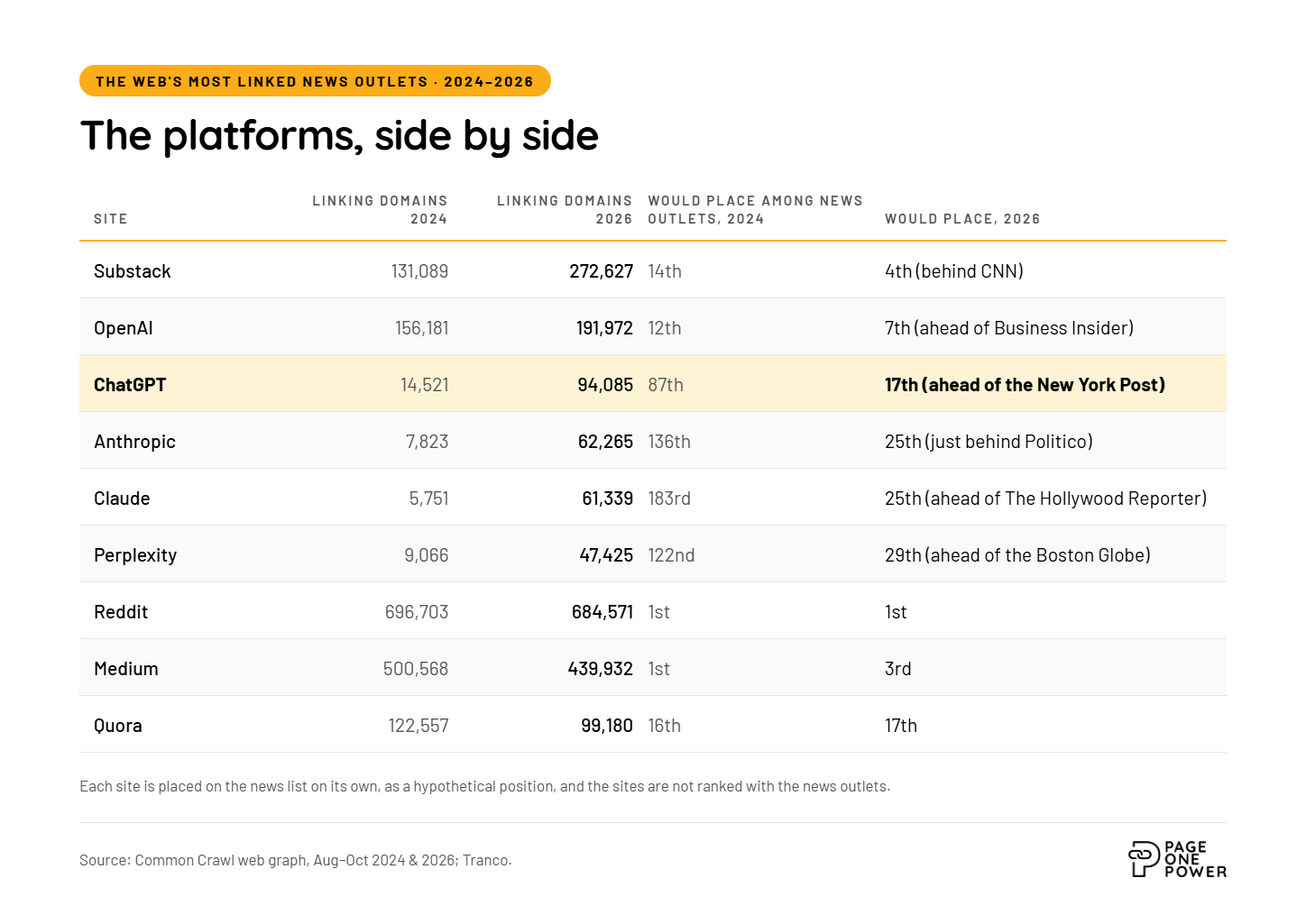
Each site is placed on the news list on its own, as a hypothetical position, and the sites are not ranked with the news outlets.
A two-speed news tier
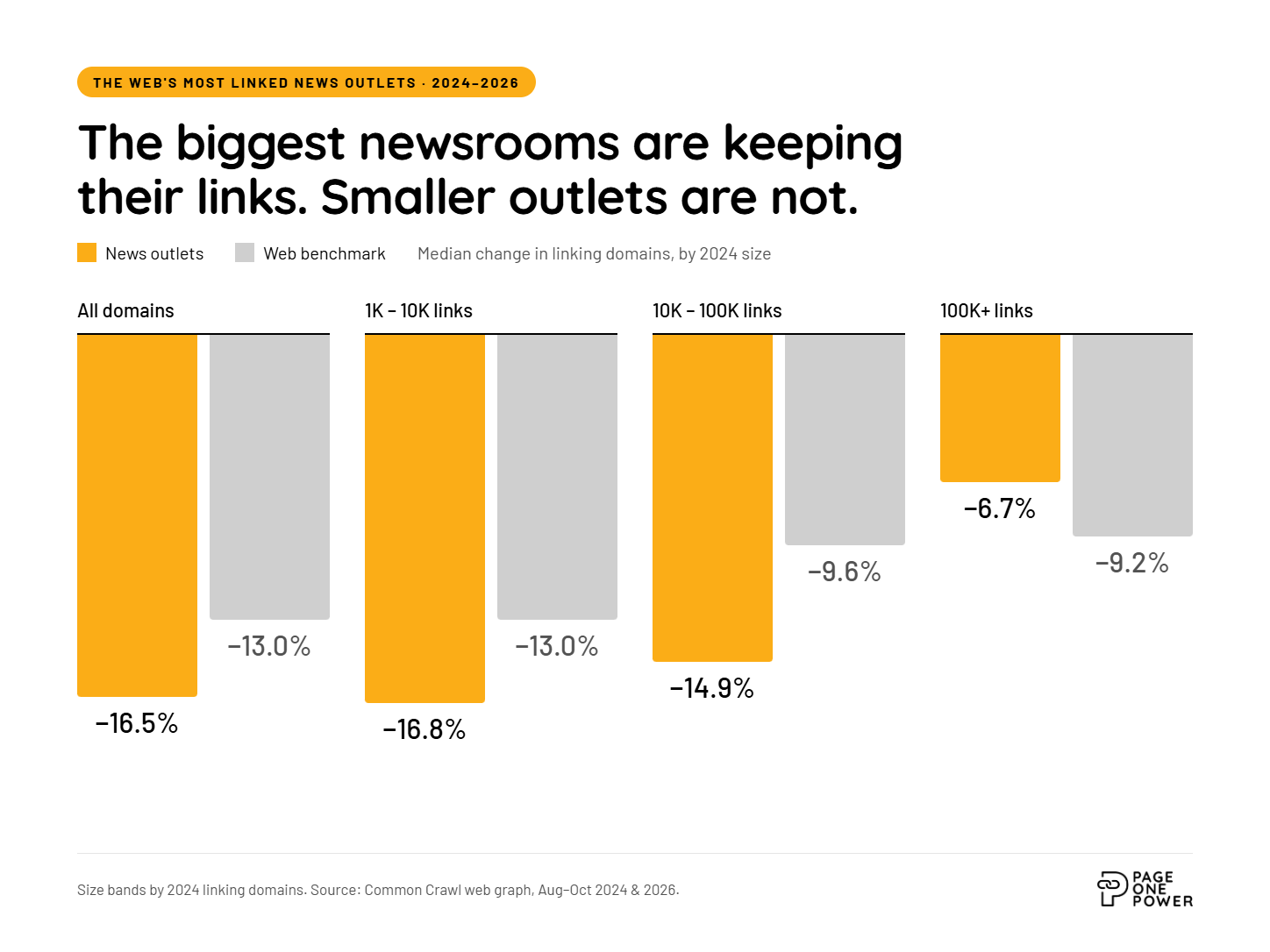
Size tracks how far an outlet fell. Among benchmark domains with 100,000 or more linking domains in 2024, the median change was -9.2%. The 17 news outlets that size did better: a median of -6.7%. The pattern flips lower down. Benchmark domains with 1,000 to 10,000 links fell a median of -13.0%, while the 653 news outlets in that band fell -16.8%, and 87% of them lost ground. The top of the pyramid is holding. The middle is sliding.
Format tracks it too. Outlets Wikidata classes as online newspapers, the digital natives, with at least 1,000 linking domains in 2024, posted a median change of -11.7%. Print outlets that size posted -16.2%.
Selected gains among outlets with 1,000+ linking domains
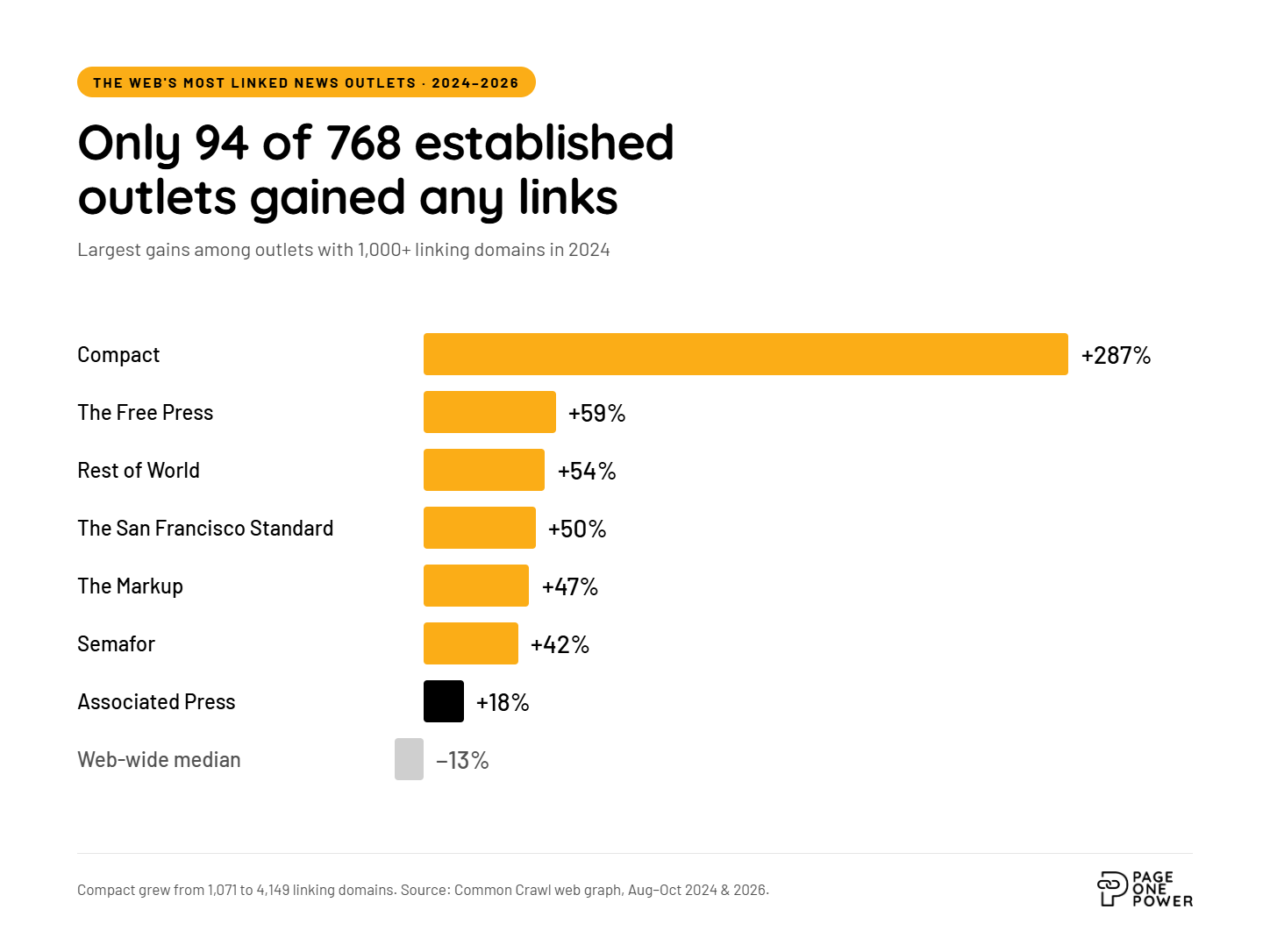
Only 94 of the 768 outlets with at least 1,000 linking domains in 2024 gained any by 2026, against a web-wide median of -13%. Among them, the largest percentage gains cluster around newsletter-era independents. Compact nearly quadrupled (1,071 to 4,149, +287%). The Free Press grew +59%, Rest of World +54%, The San Francisco Standard +50%, The Markup +47% and Semafor +42%. The Associated Press, up +18%, is the only legacy brand among them.
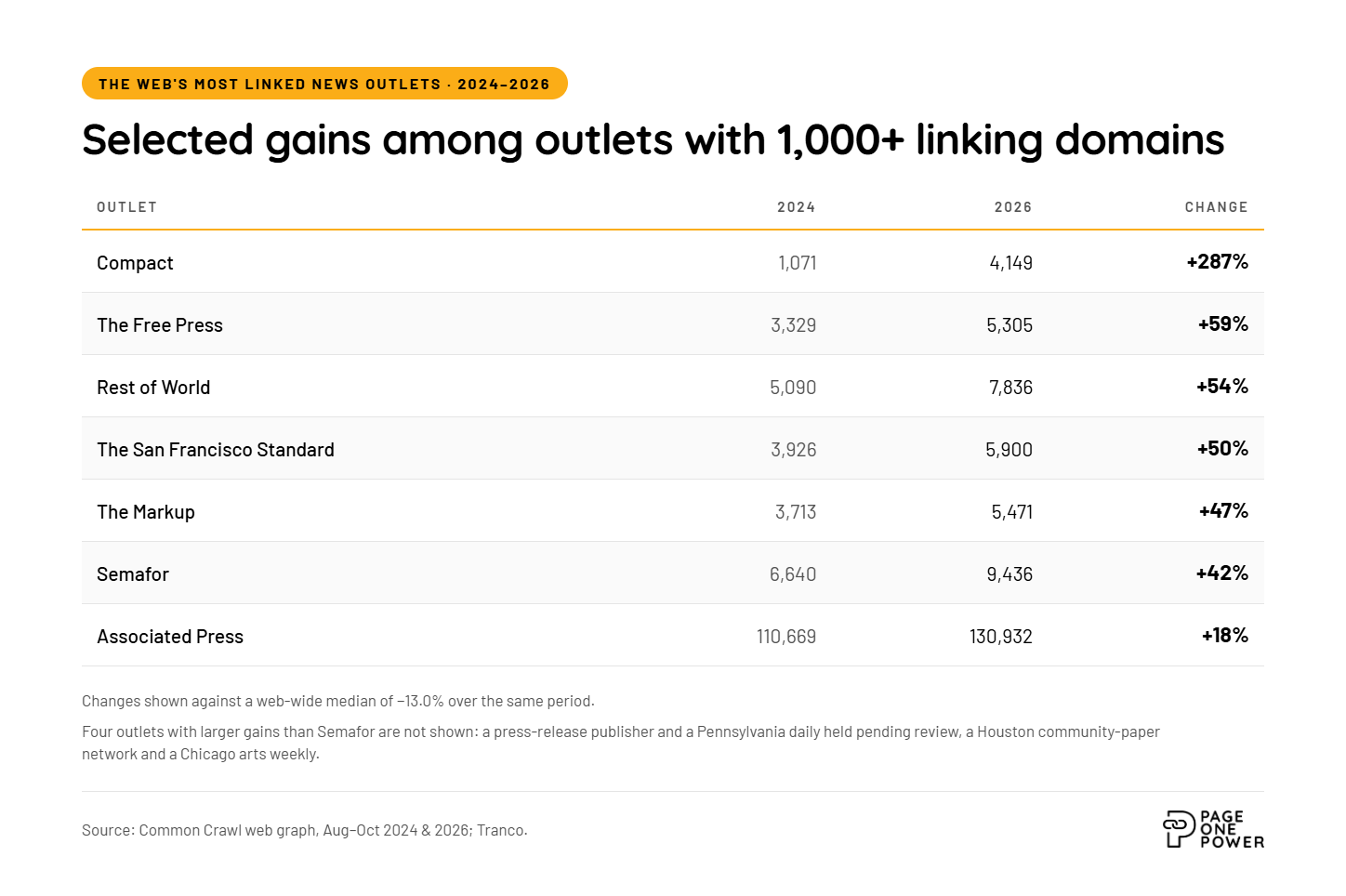 Changes shown against a web-wide median of -13.0% over the same period. Four outlets with larger gains than Semafor are not shown: a press-release publisher and a Pennsylvania daily held pending review, a Houston community-paper network and a Chicago arts weekly.
The state picture
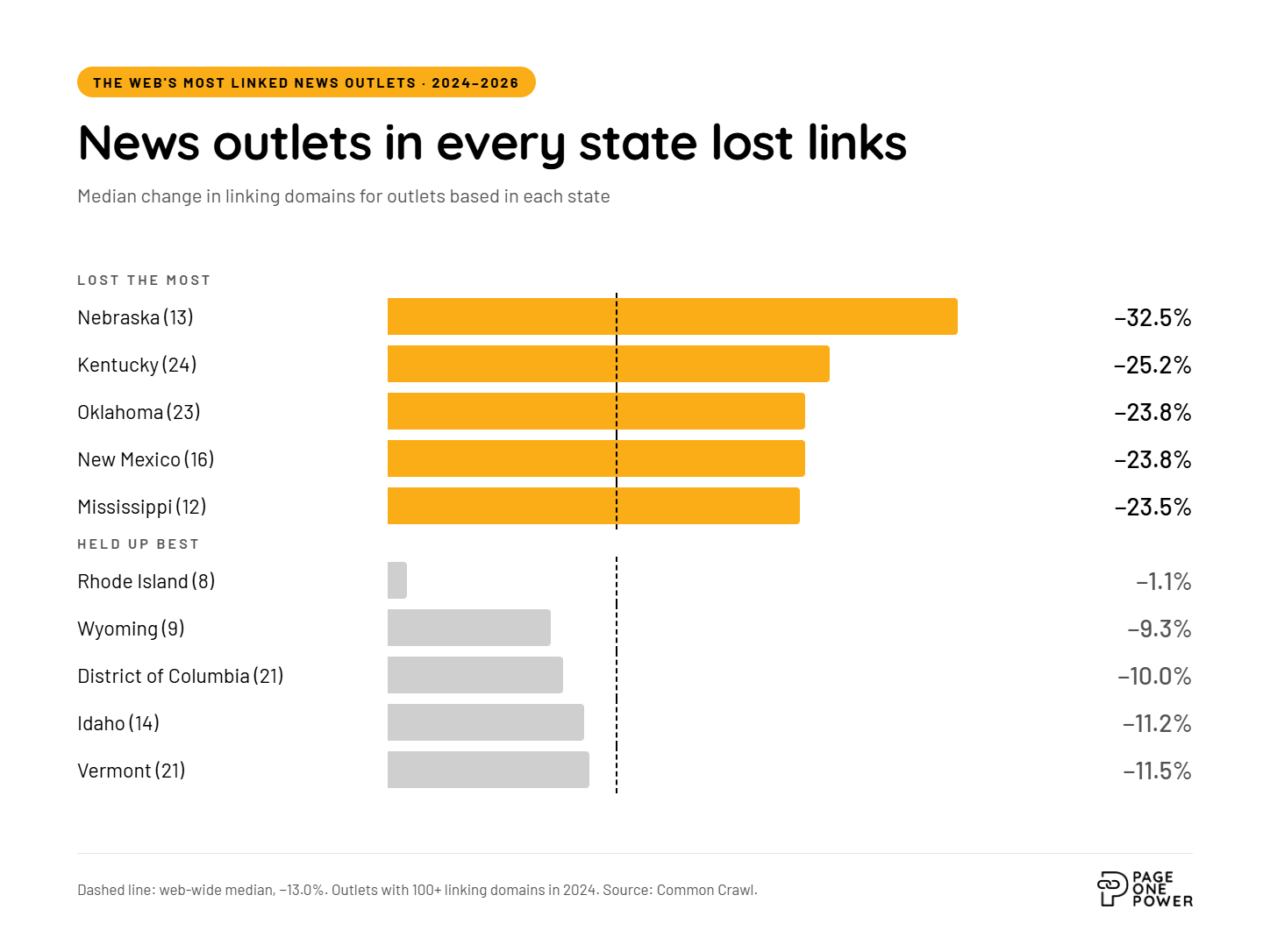
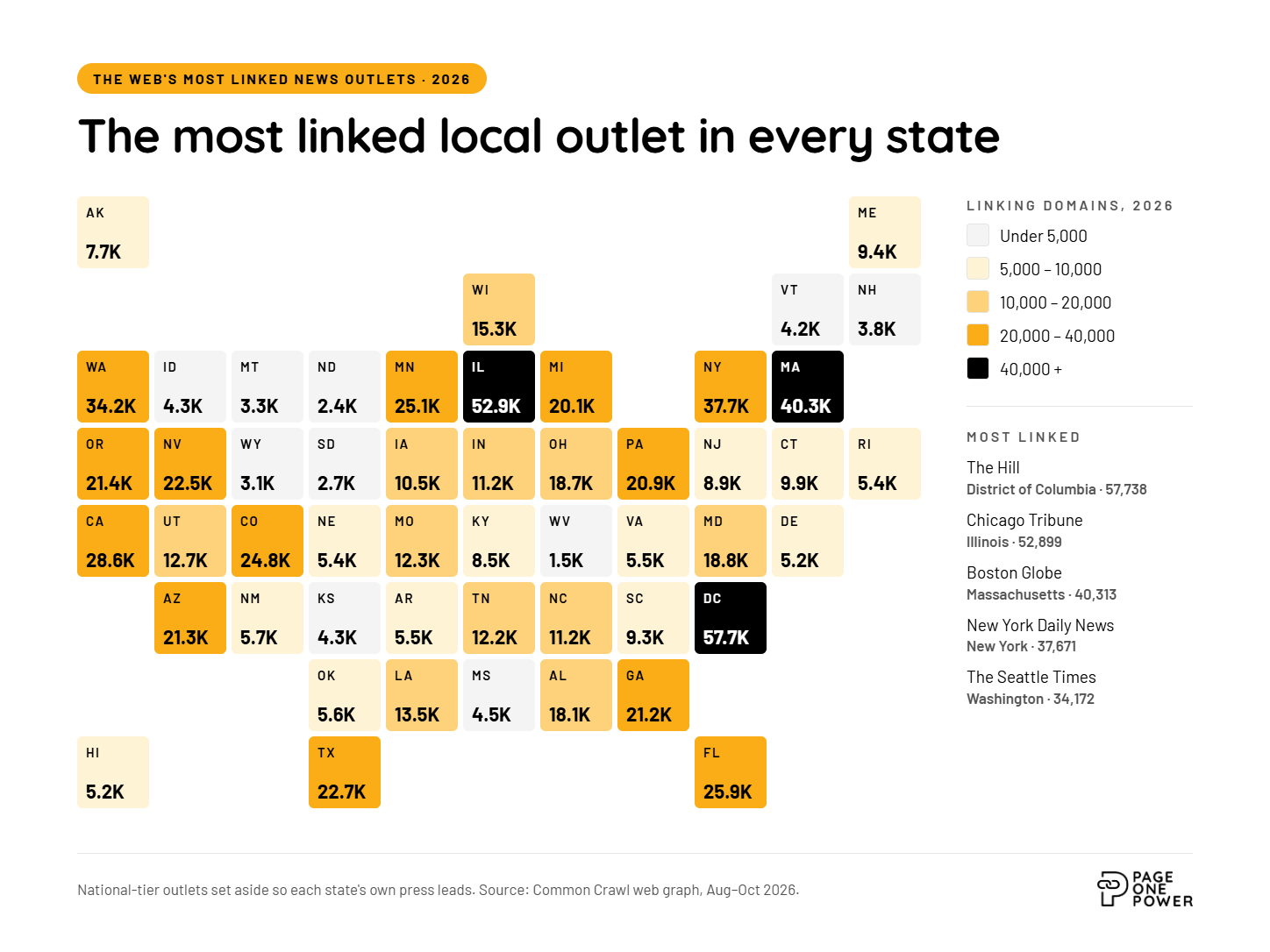
News outlets based in every state lost links, at different speeds. The median outlet based in Nebraska (13 outlets analyzed) lost 33% of its linking domains, nearly 20 points further than the web as a whole fell. Kentucky (24 outlets), Oklahoma (23), New Mexico (16) and Mississippi (12) all posted medians near -24%. At the other end, the median outlet based in Rhode Island lost just 1%, on a small base of 8 outlets, well ahead of the web benchmark, and Wyoming, also on a small base (9 outlets), held to -9%. The District of Columbia (-10%, 21 outlets), Idaho (-11%, 14) and Vermont (-11%, 21) round out the states that held up best.
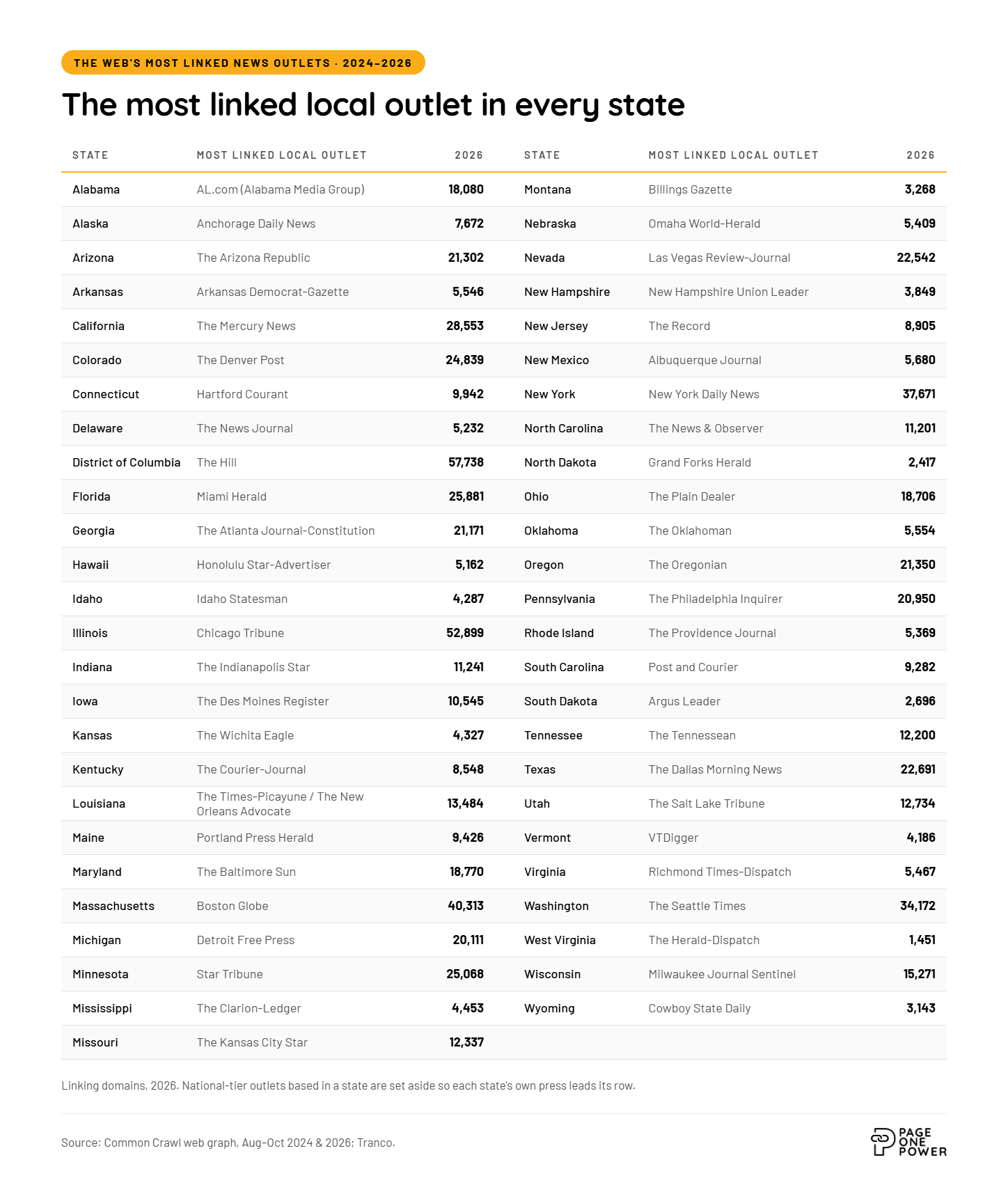
The most linked local outlet in every state, with national-tier outlets based in a state set aside so each state's own press leads its row:
What this means for communicators
From where Page One Power sits, the practical reading is about where links now accumulate. Links on the open web are pooling on platforms as well as publishers, and the publishers still holding them are the largest national newsrooms plus a short list of newer independents. For anyone whose work depends on being referenced by the domains the web links to most, that list is shorter than it was two years ago, and the gap between the sites gaining links and everyone else is widening. The durable move is earning references from the brands the web itself keeps pointing to.
Takeaway
The web still links to news, just less of it, concentrated in fewer hands. The outlets gaining ground are few, and nearly all of the biggest gains belong to newsletter-era independents, while the state tables name the outlet still carrying the most links in each corner of the country. Where the web points next is not settled, and for the newsrooms in the middle of the pack, the next two years of this map will matter more than the last two.
Methodology
This analysis counts linking domains: the number of different websites linking to a domain at least once in a given Common Crawl web graph release. A domain present in a release with zero linking domains counts as having a count for that year. Counts come from Common Crawl's August to October releases for 2024, 2025 and 2026 (the 2026 release covers 134,979,706 domains and 1,817,202,146 domain-to-domain links); popularity ranks come from Tranco's 30-day lists ending November 1 of 2024, 2025 and 2026.
The outlet list starts with every U.S.-based outlet Wikidata classes as a newspaper, daily newspaper or online newspaper with a usable official website, 2,602 outlets, plus a 12-outlet national supplement drawn from Pew Research Center's list of 30 major news sources and the Tranco top 1,000, which brings in TV networks, wire services, public radio and news magazines that Wikidata's newspaper classes miss. Reuters is excluded as non-U.S.; ABC News sits on Disney's shared go.com domain, so its links cannot be separated; outlets sharing one domain (such as nj.com) are counted once.
Because Common Crawl's 2026 release indexed more domains but fewer links per domain, raw two-year changes are shown next to a rest-of-web benchmark: every domain in the top 10,000 of any of three Tranco lists (30 days ending October 21 of 2024, 2025 and 2026; list IDs Z3ZKG, VQNLN, 746PX), excluding outlets in this study and the ten comparison platforms, with a linking-domain count in 2024 and present in the 2026 graph (11,677 domains). A 2026 count of zero is kept as a 100% decline, the same rule applied to outlets. These are earlier Tranco lists than the November 1 lists used for popularity rankings.
The benchmark is the web at large, so it includes non-U.S. news sites and portals such as Reuters, the BBC and Yahoo. Its median change was -13.0%. The 2026 release also carries many more domains with between 3,000 and 7,000 linking domains each: roughly 58,000 sit in that band in 2026, against roughly 33,000 in 2024, which stretches their rank positions from about 11,000 to about 69,000 and makes small count changes move ranks a long way. No rank-movement claims are made for outlets in that band. State medians cover each state's Wikidata outlets with at least 100 linking domains in 2024, with the national supplement set aside. The full data, code and audit log are open.
Fair Use Policy
Users are welcome to utilize the insights and findings from this study for noncommercial purposes, such as academic research, educational presentations, and personal reference. When referencing or citing this article, please ensure proper attribution to maintain the integrity of the research. Direct linking to this article is permissible, and access to the original source of information is encouraged.
For commercial use or publication purposes, including but not limited to media outlets, websites, and promotional materials, please contact the authors for permission and licensing details. We appreciate your respect for intellectual property rights and adherence to ethical citation practices. Thank you for your interest in our research.